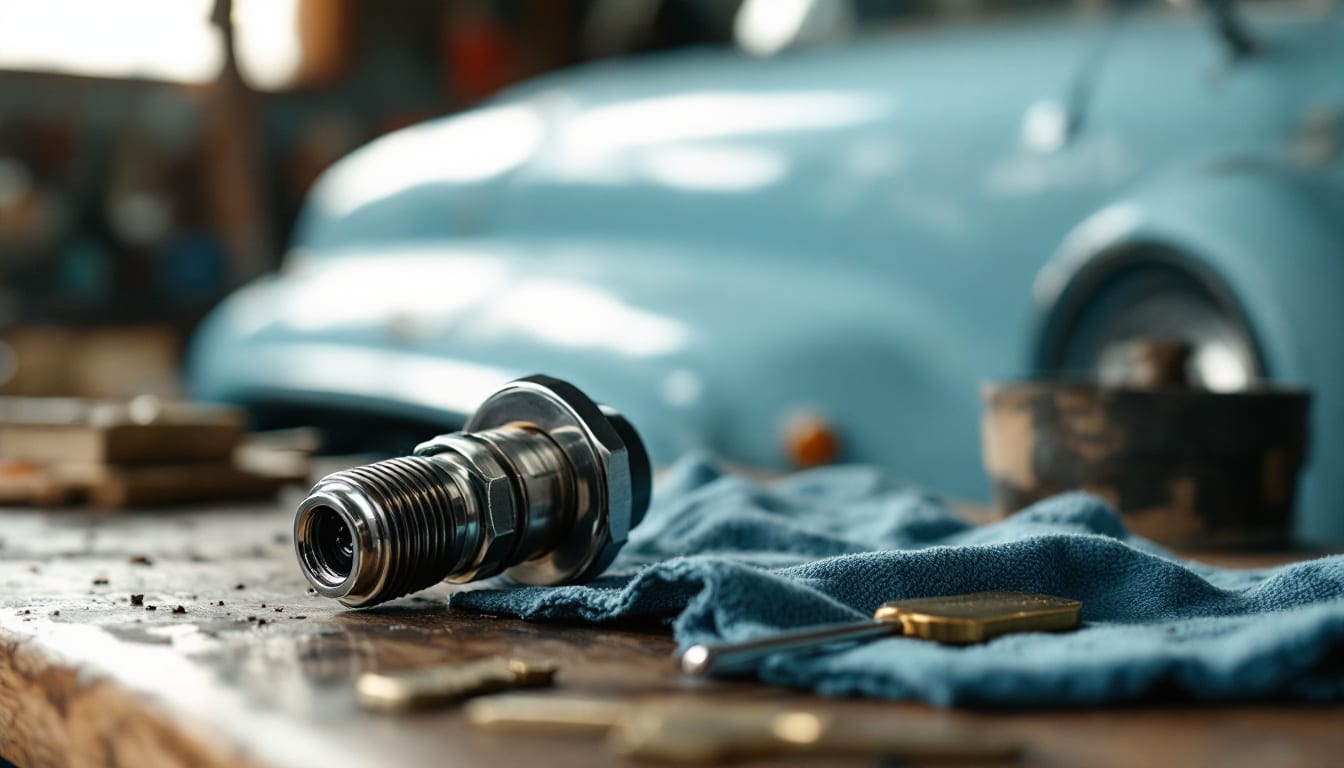
On a classic, "the ignition" is two separate parts that fail in two different ways, and the repair bill depends almost entirely on which one has gone. One is a lock. The other is an electrical switch. Call or text (817) 214-2934 and describe what the key does, and we can usually tell you which part it is before we see the vehicle.
Quick Answer
As of October 2026 in Granbury, repairing or replacing the ignition lock cylinder on a classic car or older truck typically costs $150–$350, including a key cut to fit. A fresh key on its own, when the lock is fine and the key is worn, is $75–$125. Replacing the electrical ignition switch runs $250–$500 where it is accessible. A broken key removed from the ignition is priced at the low end of our $75–$350 range, quoted after we see it. Mobile service inside 25 miles of Granbury is included.
Two Parts, One Name
Every repair conversation goes faster once these are separated.
The lock cylinder is the part the key goes into. It is mechanical. Inside are small spring-loaded wafers or pins that line up when the correct key is inserted and allow the cylinder to rotate. It wears from use, from dirt, and from decades of a heavy key ring hanging off it.
The ignition switch is the electrical part. It routes battery power to the accessory circuit, the ignition circuit, and the starter, depending on key position. It fails from heat, corrosion, and worn contacts.
On many older vehicles the two are in one housing on the dashboard. On most vehicles from about 1970 onward the lock cylinder is at the top of the steering column and the electrical switch is mounted lower on the column, joined by a rod. That change was not styling. Federal Motor Vehicle Safety Standard No. 114 required a key-locking system that also locks the steering or the vehicle's forward motion, and manufacturers met it by moving the lock to the column.
The symptoms tell you which part has failed:
- The key will not go in, will not turn, or will not come out: lock cylinder.
- The key comes out in any position, or any key turns it: lock cylinder, badly worn.
- The key turns normally but nothing powers up, or the engine dies when you let go of the key: electrical switch or its linkage.
- Accessories flicker when you wiggle the key: usually the electrical switch, sometimes the wiring behind it.
What It Costs in Granbury
| Job | Typical Granbury range (October 2026) | Notes |
|---|---|---|
| New key cut for a worn key, lock in good order | $75–$125 | Cut to the lock, not copied from the worn key |
| Key originated with nothing working | $100–$300 | Lock decoded at the vehicle, then cut and tested |
| Lock cylinder cleaned, rewafered and refitted to your existing key | $150–$350 | Keeps the original cylinder and one-key convenience |
| Lock cylinder replaced, new cylinder set to your existing key | $150–$350 | Where a correct replacement is available |
| Broken key extracted from the ignition | Low end of our $75–$350 range | Quoted on what we find; any cylinder work is separate |
| Electrical ignition switch replaced | $250–$500 where accessible | Column or dash; some dashes need trim removed |
| Door or trunk locks matched to a new ignition key | Quoted per vehicle | Depends on cylinder count and condition |
| Mobile service inside our 25-mile radius | Included in the quote | No separate trip or call-out fee |
These are the bands published on our ignition repair service page and our classic car key replacement cost guide. An older vehicle is often at the lower end, because there is no chip to program and no module to pair. What pushes a classic toward the upper end is access and parts, not electronics.
What Changes the Price
Dash-mounted or column-mounted
A dash-mounted lock on a 1960s car or an older pickup is usually the simpler job. On many of them the cylinder is released by turning the key to a set position and pressing a pin through a small hole in the face of the switch. The whole job can be done from the driver's seat.
A column-mounted lock involves more. Depending on the make and year, the steering wheel may need to come off, along with the lock plate and the turn signal switch, before the cylinder can be withdrawn. On other columns the cylinder releases from the side with the key turned to RUN. The difference between those designs is most of the difference between the low and high ends of the $150–$350 band.
Whether the key still turns
This matters more than anything else on the page. Many cylinders can only be removed cleanly with the key turned to a certain position. While the key still turns, removal is a clean job. Once it will not turn at all, the cylinder often has to be picked, forced to the release position, or drilled out, which takes longer and risks the housing around it.
If your key is getting stiff, needs a jiggle, or only works when held a certain way, that is the cheap moment to call. Our guide to a key that won't turn in the ignition of an older vehicle covers the free checks to try first.
Rebuild or replace
On a classic there are usually two ways to fix a worn cylinder.
Rebuild the original. The cylinder is removed, taken apart, cleaned, fitted with new wafers or pins matched to your key, and reassembled. You keep the original part and the original key. This is the choice for restored vehicles and for any vehicle where a correct replacement is hard to find.
Fit a new cylinder. Reproduction cylinders exist for many popular classics. They arrive with their own new keys cut to a random code. Fitted straight out of the box, that leaves you with one key for the ignition and a different one for the doors. We set the new cylinder to your existing key before it goes in, so the vehicle stays on one key.
Both sit in the same band. Which is better depends on the condition of the original and the quality of the available replacement. We will tell you which we recommend for your vehicle and why.
Parts availability
For a 1970s Chevy pickup or a Mustang, parts are on the shelf. For a low-volume or orphan make, the correct cylinder may be unavailable new, which makes a rebuild the only sensible route. Rebuilding takes longer than swapping, and the quote reflects the time.
The electrical switch and what is around it
The electrical switch on a column vehicle sits under the dash on the column, and replacing it means working around the column cover, wiring, and sometimes a knee panel. On a dash-mounted switch it means reaching behind the dash. Brittle forty-year-old connectors and previous owners' wiring repairs add time. That is why the switch band, $250–$500 where accessible, is wider than the cylinder band.
Prior repairs
A column that has been apart before, a cylinder held in with the wrong retainer, or a switch bypassed with a toggle or a push button are all common on older vehicles. Each is solvable. Each takes longer than a vehicle nobody has touched.
Matching the Symptom to the Bill
- Stiff, needs a jiggle, works with one key and not the other. Worn key. $75–$125.
- Will not turn with any key, and the steering wheel is not binding. Worn or jammed wafers. $150–$350.
- Comes out while the engine is running. Cylinder worn out. $150–$350.
- Turns freely, nothing happens, no dash lights. Electrical switch, linkage, or battery feed. $250–$500 if it is the switch.
- Engine starts, then dies when the key springs back. The run contact in the electrical switch, on vehicles with no anti-theft system. $250–$500 if it is the switch.
- Key snapped off in the lock. Brittle or worn key, often with a tight cylinder too. Low end of $75–$350, plus any cylinder work.
Not every no-start on an old vehicle is the ignition. A dead battery, a corroded ground strap, a failed starter solenoid, or a neutral safety switch out of adjustment all look similar from the driver's seat. We check the simple things before quoting ignition work, and if it is not a lock or switch problem we will tell you it is a job for your mechanic.
Keeping the Key You Already Have
Classic owners almost always ask for the same thing: fix the ignition without ending up with another key on the ring.
That is nearly always possible. A lock cylinder is set to a key by the wafers or pins inside it. Change those and the cylinder accepts a different key. When we rebuild or replace an ignition cylinder, we set it to the key that already works your doors.
It also works in the other direction. If the vehicle arrived with a mixed set of keys from earlier repairs, the ignition job is the natural time to bring everything onto one key. Our one-key rekey cost guide for classic cars explains how that is priced.
One caution. Do not have a new key copied from a badly worn one. A duplicating machine copies the wear along with the cuts. We cut to the lock's actual specification instead, which is why a new key from us often works better than the original has in years.
What the Visit Looks Like
- Proof of ownership. Title or registration and your ID, matched to the VIN. On vehicles with a missing or unreadable VIN plate we will ask for more.
- Diagnosis. We establish whether the fault is the key, the cylinder, the switch, or something outside the ignition entirely.
- A firm quote. Before any part is removed.
- The repair. Cylinder out, rebuilt or replaced and set to your key, or switch replaced. Trim on a restored interior is handled with care and takes the time it takes.
- Testing. Every key position, the steering lock where fitted, and the starter. The door locks are tested with the same key.
- A spare. If you want a second key, it is cut while the machine is set up.
Most cylinder jobs take 45 to 90 minutes on site. A column that needs the steering wheel removed, or a switch buried behind a dash, takes longer.
Doing It Yourself
Plenty of classic owners are capable of pulling a cylinder, and the parts are sold to anyone. Three things catch people out.
- Removing a cylinder that will not turn. The release usually depends on key position. Forcing it breaks the housing, and a column housing costs far more than a cylinder.
- Fitting a new cylinder with its own random key. It works, and then the vehicle has two keys for good.
- Replacing the cylinder when the switch was the fault. The new lock turns smoothly and the vehicle still does not start.
If you want to do the mechanical work yourself, we are happy to set a new cylinder to your existing key on the bench before you install it. Ask about it when you call.
Vehicles We See Most Around Hood County
A few patterns come up again and again on local vehicles.
- Full-size GM trucks from the 1970s and 1980s. Column locks with a rod-driven switch. See our square body Chevy and GMC key and ignition guide.
- Ford trucks and Broncos from 1980 to 1996. Column cylinders that release with the key in RUN. Covered in our 1980–1996 F-150 and Bronco guide.
- Fox body Mustangs. The same Ford column design, on a car that is often modified. See the Fox body Mustang key and ignition guide.
- Jeep CJ, YJ and TJ. Covered in our Jeep CJ, YJ and TJ guide.
- GM cars with a pellet in the key. An intermittent no-start on these is often the cylinder contacts, not the key. See our GM VATS key replacement cost guide.
What to Tell Us on the Phone
- Year, make, and model, and whether the ignition is on the dash or the column.
- What the key does: will not go in, will not turn, turns with nothing happening, or will not come out.
- How many keys you have, and whether one works better than another.
- Whether the same key works the doors.
- Whether the column or dash has been apart before, if you know.
- Where the vehicle is. A barn in Tolar, a garage in Pecan Plantation, a storage unit off Highway 377. All are fine.
A photo of the key and one of the ignition, texted to (817) 214-2934, usually gets you a firm range in a few minutes.
Frequently Asked Questions
How much does ignition repair cost on a classic car in Granbury? As of October 2026, lock cylinder repair or replacement typically runs $150–$350 including a key cut to fit. Replacing the electrical ignition switch runs $250–$500 where accessible. If only the key is worn, a new key is $75–$125.
What is the difference between the ignition switch and the ignition lock cylinder? The lock cylinder is the mechanical part the key goes into. The ignition switch is the electrical part that sends power to the accessories, ignition and starter. On older vehicles they may share one housing on the dash. On most vehicles from about 1970 on they are separate parts on the steering column.
Can you fix my ignition and keep my original key? Yes, in nearly every case. A rebuilt or replacement cylinder is set to the key that already works your doors, so you stay on one key.
Is it cheaper to rebuild the cylinder or replace it? They fall in the same $150–$350 band. A rebuild keeps the original part and suits restored or hard-to-find vehicles. A replacement suits vehicles with good reproduction parts available. We recommend one or the other after seeing the cylinder.
My key comes out while the engine is running. Is that a problem? Yes. It means the wafers in the cylinder are worn nearly flat. The lock is close to failing, and it will often accept other keys. It is much cheaper to repair now, while the key still turns, than after it jams.
The key turns but nothing happens. Is that the cylinder? Usually not. A key that turns normally with no power to the dash points to the electrical switch, its linkage, or the battery supply. We check the simple causes first before quoting a switch.
Do I need to tow the vehicle to a shop? No. Ignition work on older vehicles is done where the vehicle sits. Mobile service anywhere inside 25 miles of Granbury is included in the quote.
Can I buy the cylinder myself and have you key it? Yes. We can set a new cylinder to your existing key on the bench before you install it, which avoids ending up with separate ignition and door keys.
Call While the Key Still Turns
The cheapest ignition repair on a classic is the one done before the lock jams. If the key is getting stiff, comes out when it should not, or works only when held a certain way, send us the year and model and a photo of the key. Call or text (817) 214-2934, weekdays 8:00 AM to 7:00 PM, Saturdays 8:00 AM to 5:00 PM, with 24/7 emergency availability for lockouts. You can also request service through our contact page or read more about ignition repair in Granbury.
Sources
- Federal Motor Vehicle Safety Standard No. 114 — theft protection and rollaway prevention (49 CFR 571.114)
- National Highway Traffic Safety Administration
- Texas Department of Motor Vehicles — titles and registration
- National Insurance Crime Bureau
- Texas Department of Public Safety — Private Security Program
- Associated Locksmiths of America