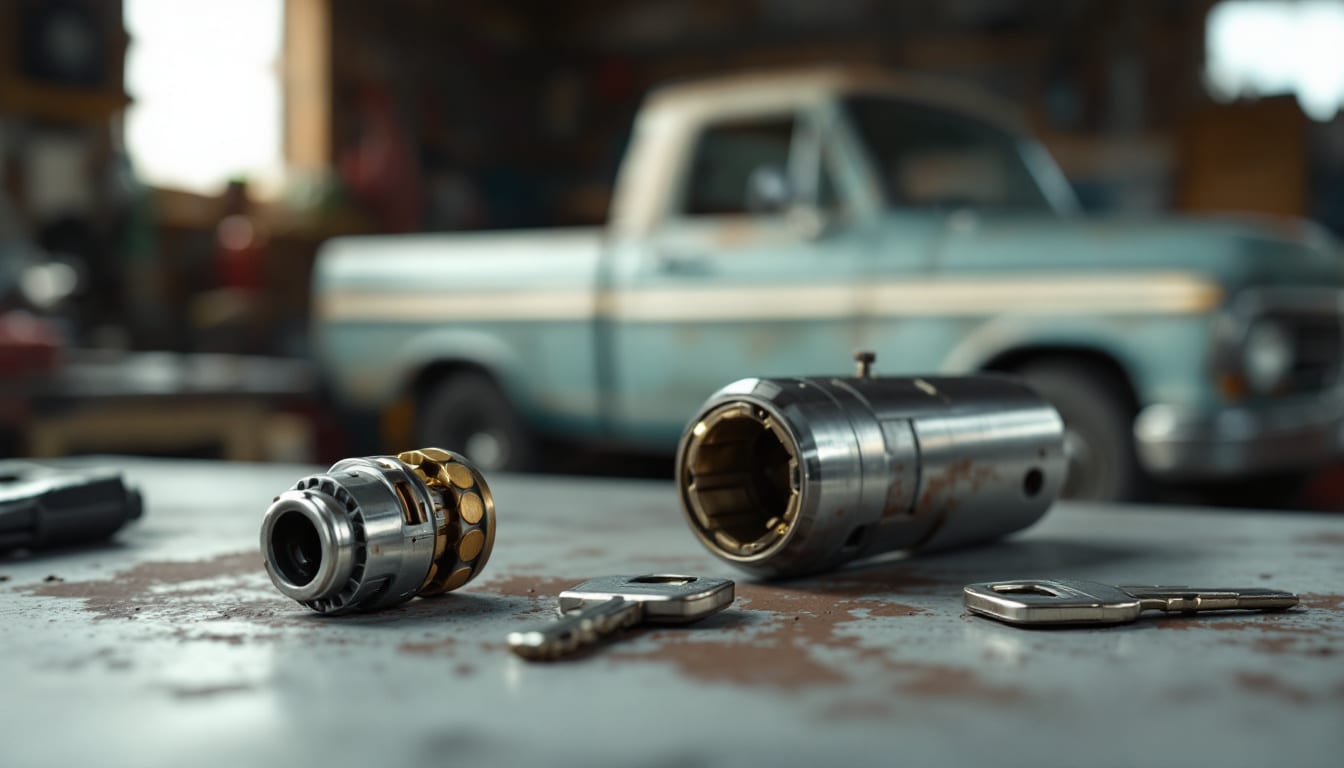
The key slides all the way in. It just will not turn. On an older truck or a classic, that is one of the most fixable problems there is — as long as nobody forces it first. Call or text (817) 214-2934 if you want it handled at the vehicle.
Quick Answer
As of September 2026, a key that will not turn in an older vehicle's ignition is usually one of five things, in this order of likelihood: the steering wheel is binding the lock, the key is worn (or is a copy of a copy), the wafers in the cylinder are worn or dirty, something is in the keyway, or the cylinder has failed mechanically. The first two you can test yourself in under a minute at no cost. If it comes down to the cylinder, ignition repair or replacement in Granbury typically runs $150–$350, and a freshly cut key on its own is $75–$125.
Before Anything Else: Do Not Force It
The most expensive version of this problem is a key snapped off inside the cylinder. Steel keys that are decades old are fatigued, and the leverage your wrist can apply is more than enough.
Two rules:
No pliers. No screwdriver. No hammer. A screwdriver turned in an ignition destroys the cylinder and often the lock housing behind it, which converts a $150–$350 job into a much larger one.
No lubricant that is not made for locks. Penetrating oil and general-purpose spray lubricants attract dust, and in a Hood County summer that turns into a paste inside the cylinder that guarantees the failure you are trying to avoid. Dry graphite or a proper lock lubricant only.
Work Through It In This Order
1. Unload the steering lock (30 seconds, free)
This is the single most common cause and it is not a fault at all.
When you park, the steering column's lock pin drops into a slot. If the front wheels are turned, or the vehicle is parked against a curb or on a slope, the weight of the vehicle loads that pin against the slot. The ignition physically cannot rotate until the load comes off.
The test: put light pressure on the key in the direction it should turn — light, not hard — and at the same time rock the steering wheel firmly left and right. Nine times out of ten it releases with a small click and the key turns.
If your vehicle has an automatic transmission, also make sure the shifter is fully in Park. A shifter resting a few degrees short of the detent will hold the interlock engaged.
2. Try the other key, and look at the one in your hand
Pull the key out and look at the blade edge-on against a light.
A key that has been in a pocket for twenty years has a rounded profile — the sharp peaks and valleys the wafers need have been polished into gentle hills. That key may have worked yesterday, because wear is gradual until it is not.
The test: try a different key if one exists. If a second key turns and the first does not, your problem is a $75–$125 key, not a $150–$350 cylinder.
There is a version of this that catches people out. A key that is itself a copy of a copy can be off-specification enough to fail even though it is not visibly worn. Each duplication drifts a little from the original. If your current key came from a machine that traced another duplicate, having a key cut to the lock rather than traced from the worn one is the fix — same price, correct specification. That is covered in more depth in our classic car key cost guide.
3. Check the keyway for debris
Older vehicles collect what the environment gives them: dust, pocket lint, a broken-off piece of a previous key, or wasp mud on a truck that sat in a barn.
The test: shine a light straight into the keyway. If the key does not seat all the way to the shoulder, something is in there. Compressed air is worth one try. A paperclip is not — you will pack the debris tighter.
4. Wiggle test the cylinder itself
Insert the key and apply gentle turning pressure while lifting the key very slightly, then pressing it down slightly.
If it turns in one specific position and not in others, the wafers are worn and only agreeing with the worn key at one exact alignment. That is a cylinder that is going to fail — maybe next month, maybe at a ramp in July. It is a warning, not a verdict.
If the key turns with no resistance at all and nothing happens, that is different and more serious: the cylinder is spinning without engaging, which usually means the lock's internal retainer or the actuator behind it has failed.
5. Cold in the morning, fine in the afternoon
Metal expands and contracts. A cylinder that only misbehaves at temperature extremes is already marginal — tolerances that are borderline at 70 degrees stop working at 25 or 105. In Hood County that shows up in January mornings and August afternoons.
This one almost never fixes itself. It is a cylinder on the way out, and replacing it on your schedule is meaningfully cheaper than replacing it on the vehicle's.
What Each Cause Costs in Granbury
| Actual cause | Fix | Typical Granbury range (August 2026) |
|---|---|---|
| Steering lock binding | Rock the wheel — nothing to buy | Free |
| Shifter not fully in Park | Seat the shifter | Free |
| Worn or copy-of-a-copy key | New key cut to the lock | $75–$125 |
| No key at all, needs originating | Decode and cut | $100–$300 |
| Debris in the keyway | Clean and lubricate | Low end of our $75–$350 range |
| Worn wafers in the cylinder | Cylinder repair or replacement | $150–$350 |
| Key broken off in the cylinder | Extraction, then key or cylinder work | Low end of $75–$350, plus any cylinder work |
| Cylinder spins with no engagement | Cylinder or actuator replacement | $150–$350 |
| Vehicle locked with keys inside | Damage-free entry | From $50–$75 |
A dealer that will still work on an older vehicle typically starts around $200–$600 for ignition work and requires the vehicle on their lot, which for a truck that will not start means a tow first. Mobile pricing here runs 40–60% below dealer for equivalent work, and the comparison is laid out in ignition switch repair: locksmith vs dealer.
When It Is Not the Lock at All
Two situations look identical from the driver's seat and are not lock problems.
The key turns fine but the engine cranks and will not run. That is not a mechanical lock failure. On a vehicle with an anti-theft system, it means the vehicle refused to authorize the key. On many GM cars from the late 1980s and 1990s that is a resistor pellet in the key blade; on later vehicles it is a chip in the key head or a sensor in the lock cylinder. Different diagnosis entirely — see our transponder key guide if the vehicle has a chipped key, or the immobilizer and module programming guide if the vehicle's security module itself is refusing.
The key turns and absolutely nothing happens — no crank, no dash lights. That is electrical, not mechanical: battery, ground, ignition switch contacts behind the cylinder, or a starter circuit. The lock did its job. On boats, ATVs, and similar equipment this is common enough that we wrote it up separately in boat or ATV key turns but nothing happens.
The Cylinder Repair Itself
When it does come down to the lock, here is what happens at your vehicle so there are no surprises.
Access. On most older trucks and cars the cylinder is retained by a pin or a spring clip behind trim. Steering-column work on a classic is careful work — the parts are old, the plastic is brittle, and the airbag question has to be answered before anything comes apart on vehicles that have one.
Removal. The cylinder comes out, sometimes with the key, sometimes without. Removing a cylinder with no key is a specific skill and is where the difference between a locksmith and a general mechanic shows up.
Decode or rekey. The new cylinder is either keyed to match your existing key — so you keep one key for the whole vehicle — or a new key is cut and you know it is the only one that works.
Reassembly and test. Every position: accessory, run, start, and the key coming back out cleanly. Then the doors, so you leave with a documented picture of which locks agree with which key.
Typical time on site is 45 to 90 minutes for a straightforward cylinder, longer on a column that has been apart before or on a restored vehicle where the trim deserves care.
One timing point that decides the price more than anything else on this page: on many column designs, including a lot of Ford columns from the 1980s and early 1990s, the cylinder is released for removal with the key turned to RUN. While the key still turns, replacement is a clean job. Once it will not turn at all, the cylinder usually has to be drilled out, which takes longer and is harder on the column. Our Fox body Mustang key and ignition guide walks through that on one of the most common examples. The same wear pattern shows up on boat dashes, where a stiff switch usually turns into a boat key stuck in the ignition before it fails outright.
Keep the Old Cylinder Conversation Honest
One thing worth saying plainly: on an older vehicle, matching a new cylinder to your existing key is usually possible and is usually what people want. It avoids the "now I have two keys and neither does everything" outcome that older vehicles accumulate.
But if your existing key is the worn one that caused the failure, keying a brand-new cylinder to that worn key hands the new lock its first mistake. The better version is to cut a fresh key to specification and key the new cylinder to that, then rekey the doors to match at the same visit if you want one key for everything. See car lock rekey for how that works.
Frequently Asked Questions
Why will my key not turn in the ignition? Most often the steering lock is under load — rock the wheel while applying light turning pressure and it usually releases. After that, the likely causes are a worn key, worn wafers in the cylinder, debris in the keyway, or a mechanically failed cylinder. Test the free causes before spending anything.
How much does ignition repair cost in Granbury? Ignition cylinder repair or replacement typically runs $150–$350 as of August 2026, including cutting a key to the new cylinder. If the real problem turns out to be the key rather than the lock, a new key cut to the lock is $75–$125.
Can I spray WD-40 in my ignition? No. General-purpose penetrating sprays attract dust and grit, and in Texas heat that becomes a paste inside the cylinder that makes the failure worse. Use dry graphite or a lubricant made for locks, sparingly.
My key turns but the engine cranks and will not start. Is that the ignition lock? No. A key that turns has already satisfied the mechanical lock. Cranking without starting on a vehicle with anti-theft means the system refused to authorize the key — a resistor pellet, a chip, or a lock-cylinder sensor depending on the vehicle and year.
Should I replace the whole ignition switch or just the lock cylinder? They are two different parts. The cylinder is the lock the key goes into; the switch is the electrical component behind it. A key that will not turn is a cylinder problem. No power in the run position with a key that turns fine is a switch problem. We diagnose which before quoting.
Can you match a new cylinder to my current key? Usually yes, and on older vehicles that is generally the right call so you keep one key for the whole vehicle. The exception is when your current key is the worn one that caused the failure — then it is better to cut a fresh key to specification first.
Do you come out, or does the vehicle have to be towed? We come to you. Ignition work happens at your driveway, barn, shop, or the roadside anywhere within 25 miles of Granbury. That is the entire point of mobile service on a vehicle that will not start.
Get It Diagnosed Before It Breaks Off
If your key will not turn in an older vehicle around Granbury, call or text (817) 214-2934 with the year, make, model, and which of the tests above changed anything. Serving Granbury, Acton, DeCordova, Pecan Plantation, Tolar, Lipan, Cresson, Nemo, Bluff Dale, Glen Rose, and 25 miles out. Weekdays 8:00 AM to 7:00 PM, Saturdays 8:00 AM to 5:00 PM, with 24/7 emergency availability. You can also request service through our contact page or read more on our ignition repair page.
Sources
- Texas Department of Public Safety — Private Security Program
- National Highway Traffic Safety Administration — Vehicle Theft Prevention
- Associated Locksmiths of America
- National Automotive Service Task Force — Vehicle Security Professional Program
- Federal Trade Commission — How to Find a Good Auto Repair Shop