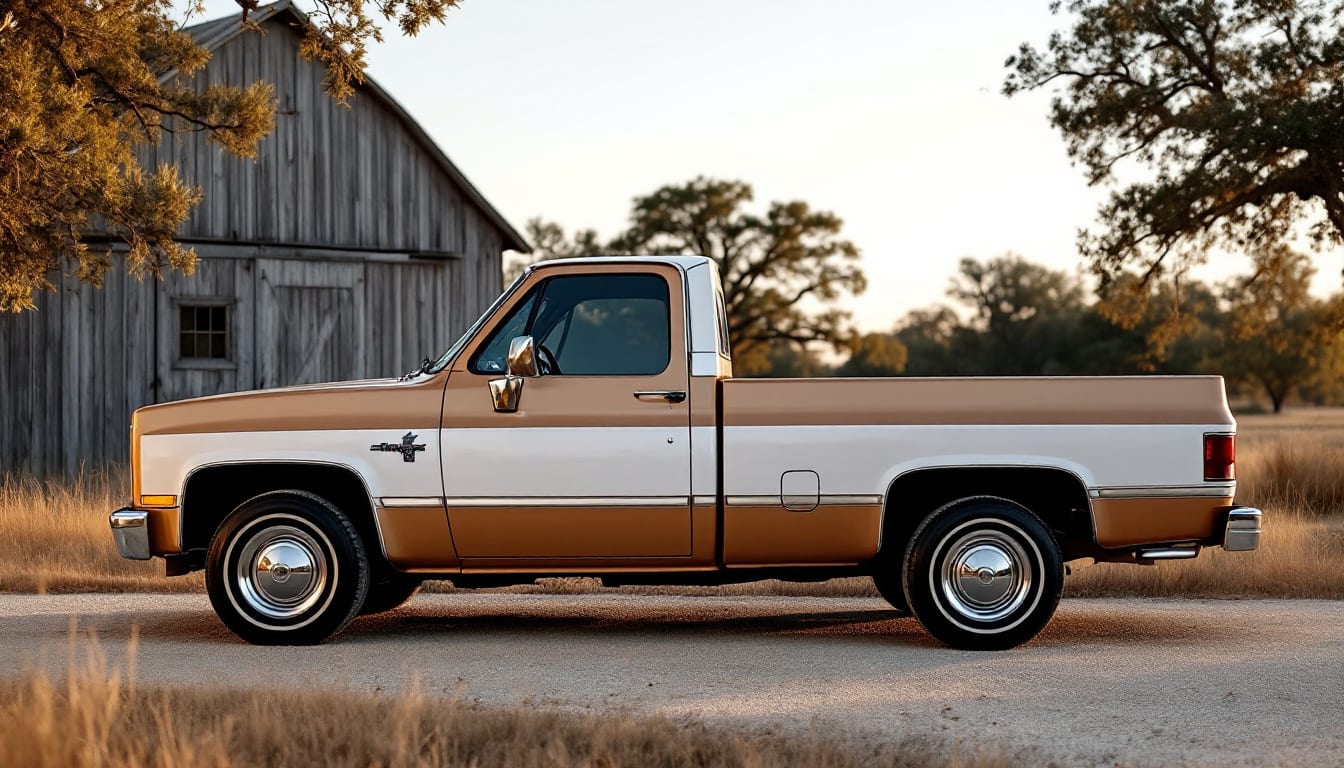
The 1973 to 1987 Chevrolet and GMC trucks, the ones everybody now calls square bodies, went from farm trucks to collectibles without ever leaving Hood County. Plenty of them still work for a living. Almost all of them have a key story: one worn key, a door that takes a different key from the ignition, or a tailgate window that has not been unlocked in years. Call or text (817) 214-2934 and we will sort it out at the truck.
Quick Answer
A 1973–1987 Chevy or GMC square body truck uses a plain mechanical key with no chip and no resistor pellet. As of October 2026 in Granbury, copying a working key costs $75–$125, making a key with nothing working costs $100–$300, and ignition lock cylinder repair or replacement runs $150–$350 including a key. These trucks were built with two key patterns, so a key that starts the truck may not open every lock. Mobile service inside 25 miles of Granbury is included in the quote.
Which Trucks This Covers
The square body generation covers the full-size GM light trucks built on the same cab and body design:
- Chevrolet C10, C20, C30 and K10, K20, K30 pickups. C is two-wheel drive, K is four-wheel drive.
- GMC C and K series pickups, sold as the Sierra, High Sierra, and Sierra Classic among other trims.
- Chevrolet K5 Blazer and GMC Jimmy.
- Chevrolet and GMC Suburban.
The pickups were replaced for 1988. The Blazer, Jimmy, Suburban, and the crew cab and one-ton trucks carried on with the same body, renamed R and V series, into 1991. Everything on this page applies to those later trucks too.
The trucks that came next are covered in our 1988–1998 C/K 1500 and Suburban key guide.
The Key: as Simple as Truck Keys Get
A square body key is a flat, single-sided GM key. The cuts are along one edge only, and it goes into the lock one way up. There is no transponder chip in the head, no resistor pellet in the blade, and no electronic anti-theft system on the truck from the factory.
Three things follow from that.
It is the cheapest truck key we make. There is nothing to program. A key is cut, tested, and done.
Any correctly cut key starts the truck. The truck does not know or care which key is in it, only whether the cuts are right.
It is easy to steal. We come back to that further down.
Two key patterns from the factory
General Motors delivered these trucks with two different keys, one with a square head and one with an oval head. One pattern was the primary key and the other covered secondary locks. Which locks each one worked varied with the year and the way the truck was equipped, so on a forty-year-old truck we test every lock rather than assume.
What that means in practice:
- A key that starts the truck and will not open the glovebox, or the tailgate window on a Blazer, is not necessarily a fault. It may be how the truck was built.
- The secondary key is almost always the one that has gone missing.
- After forty years of replaced door cylinders, donor columns, and swap-meet parts, many trucks carry three or four unrelated key patterns.
What It Costs in Granbury
| Job | Typical Granbury range (October 2026) | Notes |
|---|---|---|
| Copy a working key | $75–$125 | Cut to the lock's correct depths, not traced from a worn key |
| Key made with nothing working | $100–$300 | A lock is decoded at the truck, then the key is cut and tested |
| Second key pattern made (glovebox, tailgate) | $100–$300 with no original | Less when done on the same visit as the first |
| Ignition lock cylinder repair or replacement | $150–$350 | Set to your existing key, with a key included |
| Door or tailgate locks rekeyed to one key | Quoted per vehicle | Depends on cylinder count and condition |
| Broken key extracted | Low end of our $75–$350 range | Quoted after we see the break |
| Truck unlocked with keys inside | From $50–$75 | See car lockout service |
| Mobile service inside our 25-mile radius | Included in the quote | No separate trip or call-out fee |
These are the same bands as our classic car key replacement cost guide.
Making a Key With Nothing Working
The usual square body call is not a key lost yesterday. It is a truck bought at an estate sale near Tolar, or pulled out of a barn in Lipan, with no key or with a key that only half works.
The job runs in this order:
- Proof of ownership. Title or registration and matching ID. A truck with no title is a separate conversation, covered below.
- Look for a code. GM stamped key codes on some lock cylinders of this period. If a door or glovebox cylinder carries a readable code, the key is cut from it directly.
- Decode a lock. If there is no code, a door cylinder is decoded. Door locks are the easiest to reach. The cylinder is held in the door by a clip on the inside of the door skin.
- Cut and test. The key is tested in the door, then the ignition, then everything else. The order tells us quickly whether the truck is still on its original pattern.
- Deal with mismatches. If the ignition does not match the doors, you choose between carrying two keys or having the odd cylinder rekeyed to match.
Expect 45 to 90 minutes on site. The truck does not need to run.
The Ignition: Lock at the Top, Switch at the Bottom
The square body has its ignition lock on the right side of the steering column. That lock is purely mechanical. The electrical ignition switch is a separate part mounted lower down on the column, under the dash, and the two are connected by a rod.
Between the lock cylinder and the rod sits a small gear and a toothed rack inside the column head. Turning the key turns the gear, the gear moves the rack, the rack moves the rod, and the rod slides the electrical switch.
Knowing that layout explains the common faults.
The key will not turn. Usually worn wafers in the lock cylinder, a worn key, or the steering lock under load. Turn the wheel slightly left and right while turning the key before deciding the lock has failed.
The key turns and comes out in any position. The cylinder is worn out. The truck will also start with keys that should not fit it.
The key turns normally and nothing happens. On these columns, this is often not the lock cylinder at all. The gear or rack inside the column has broken or stripped, so the key turns and the rod never moves. It can also be the electrical switch or its adjustment on the column.
The truck starts and the key will not return, or the steering does not lock. Linkage inside the column head again.
The lock cylinder is a locksmith job and falls in the $150–$350 band. It comes out of the column after the steering wheel and the lock plate behind it are removed, so it is a longer job than on a truck where the cylinder releases from the side. Internal column parts and the electrical switch are column repairs. We will tell you which one you have before any parts are bought. A truck with a loose, wobbly tilt column usually needs a mechanic to tighten the column before any lock work is worth doing.
If the key is stiff or needs a jiggle, our guide to a truck key that won't turn in the ignition has the free checks to try first. For what the ignition work costs across older vehicles, see the classic car ignition repair cost guide.
Doors, Tailgates, and the Blazer Rear Window
Doors. Square body door locks are simple wafer cylinders. They wear, and they also fall victim to bent lock rods and worn door handles, which feel like a lock problem and are not. If the key turns and the door does not unlock, the fault is in the rod or latch inside the door.
Pickup tailgates. Most pickup tailgates on these trucks have no lock. A locking tailgate handle is a common later addition, and it will have its own key unless somebody has matched it.
Blazer, Jimmy, and Suburban tailgates. On trucks with a drop tailgate and a power rear window, the glass is lowered by a key switch on the tailgate as well as a switch on the dash. That key switch sits outside in the weather and is used rarely. It is one of the most frequently seized locks we see on these trucks, and it is often on the secondary key pattern that nobody has any more. A key can be made for it, and it can be rekeyed to match the ignition key.
Glovebox. A small, simple lock, and frequently the last cylinder on the truck that is still original. That makes it useful for working out what the truck's factory key patterns were.
Add-ons. Toolboxes, camper shells, and locking fuel caps are all separate locks with separate keys. Our truck toolbox, tailgate and camper shell rekey cost guide covers those.
One Key for the Whole Truck
On a restored truck, or one being restored, putting everything on one key is worth doing once and properly. The ignition, both doors, the glovebox, and the tailgate lock or window switch can all be set to the same key.
There are two ways it gets done:
- Rekey the original cylinders. Each lock is taken apart and its wafers are changed to match the chosen key. This keeps original parts on the truck.
- Fit new cylinders set to one key. Reproduction lock sets are sold for these trucks, and they suit a truck whose original locks are worn out or missing. We set them to match each other, and to your existing key if you want to keep it.
Either way it is quoted per vehicle. Our one-key rekey cost guide explains what goes into the quote.
Theft: the Honest Part
A square body has no immobilizer. The door locks are basic and the ignition is a design that thieves have understood for fifty years. Clean examples now sell for serious money. That is a poor combination.
The National Insurance Crime Bureau continues to report on vehicle theft across the country, and older vehicles without electronic immobilizers are consistently easier targets than modern ones. Nothing a locksmith does to the original locks changes that fundamentally.
What does help:
- Fresh, tight locks. A worn ignition that accepts any key is not a lock at all. Replacing a worn-out cylinder restores what protection the design had.
- A visible steering wheel lock. Old-fashioned, and still a deterrent.
- A hidden cut-off switch, fitted by a mechanic or auto electrician.
- Where it sleeps. In a locked building, not on the street.
- Rekey after purchase. If you bought the truck from a stranger, you do not know how many keys are out there. Our guide to rekeying a used vehicle covers the reasoning and the cost.
No Title, Barn Find, or Inherited Truck
We check ownership on every job, and old trucks are where that gets complicated.
- Inherited trucks. Bring the title and whatever estate paperwork shows the truck is yours to deal with.
- Bill of sale only. A bill of sale helps and is not a title. The Texas Department of Motor Vehicles has a bonded title process for vehicles with missing ownership documents. It is worth starting before the restoration, not after.
- VIN. Depending on the year, the VIN plate is on the driver's door jamb or at the base of the windshield. It should match the paperwork.
We are not being difficult. Locksmiths in Texas are licensed through the Texas Department of Public Safety Private Security Program, and making a key for a vehicle without checking ownership is exactly what that licensing exists to prevent.
Swapped Columns and Modern Engines
Many square bodies now run a later steering column, a later engine, or both.
- A later GM column brings its own ignition lock, and possibly a later key type. The key for the column is then nothing to do with the truck's year.
- A modern engine swap with its factory computer may bring an anti-theft system that expects a signal the old truck cannot send. That is normally handled in the engine computer's programming by whoever did the swap. It is not a key problem, though it looks like one when the truck cranks and will not run.
Tell us about any swap on the phone. It changes what we bring.
What to Send Us Before We Come Out
Text these to (817) 214-2934:
- Year and model, and whether it is a pickup, Blazer, Jimmy, or Suburban.
- A photo of every key you have.
- Which locks each key works, as far as you know.
- What the ignition does: will not turn, turns with nothing happening, or key comes out while running.
- Any swaps: column, engine, doors.
- Where the truck is, and whether it rolls.
- Proof of ownership.
We come to Granbury, Acton, Tolar, Lipan, Glen Rose, Cresson, and anywhere else inside our 25-mile radius.
Frequently Asked Questions
Does a square body Chevy or GMC key have a chip? No. The 1973–1987 trucks use a plain mechanical key with no transponder chip and no resistor pellet. That is why a copy costs $75–$125 and needs no programming.
How much does a key cost for a 1973–1987 Chevy truck in Granbury? As of October 2026, $75–$125 to copy a working key and $100–$300 to make one with nothing working, because a lock has to be decoded first. The price is quoted before we start.
Why does my key start the truck but not open the glovebox or tailgate window? These trucks were built with two key patterns. The key that runs the ignition may never have fitted the secondary locks. A second key can be made, or those locks can be rekeyed to the ignition key.
My key turns in the ignition and nothing happens. Is it the lock cylinder? Often not on these trucks. A gear and rack inside the column connect the lock to the electrical switch by a rod, and when they strip or break the key turns freely with no effect. That is a column repair. We diagnose it before any parts are bought.
Can you make a key for a barn-find truck with no keys? Yes, with proof of ownership. A door or glovebox lock is decoded at the truck, a key is cut, and every lock is tested. The truck does not need to run.
Can the whole truck be put on one key? Yes. The ignition, doors, glovebox, and tailgate lock or window switch can all be set to the same key, either by rekeying the original cylinders or by fitting new ones. It is quoted per vehicle.
How do I stop my square body being stolen? The truck has no immobilizer, so layer the basics: an ignition cylinder that is not worn out, a visible steering wheel lock, a hidden cut-off switch fitted by a mechanic, and secure storage.
Do you come out to rural properties? Yes. Mobile service anywhere inside 25 miles of Granbury is included in the quote, with no separate trip fee.
One Key, Cut Right
A square body is one of the easiest trucks on the road to get keyed properly, and one of the most common to find in a muddle. Send us photos of the keys you have and tell us which locks they work. Call or text (817) 214-2934, weekdays 8:00 AM to 7:00 PM, Saturdays 8:00 AM to 5:00 PM, with 24/7 emergency availability for lockouts. You can also request service through our contact page or read about our Chevy key replacement service in Granbury.
Sources
- GM Heritage Center
- National Insurance Crime Bureau — vehicle theft data and reports
- Texas Department of Motor Vehicles — buying or selling a vehicle, titles
- National Highway Traffic Safety Administration — vehicle theft prevention
- Texas Department of Public Safety — Private Security Program
- Associated Locksmiths of America