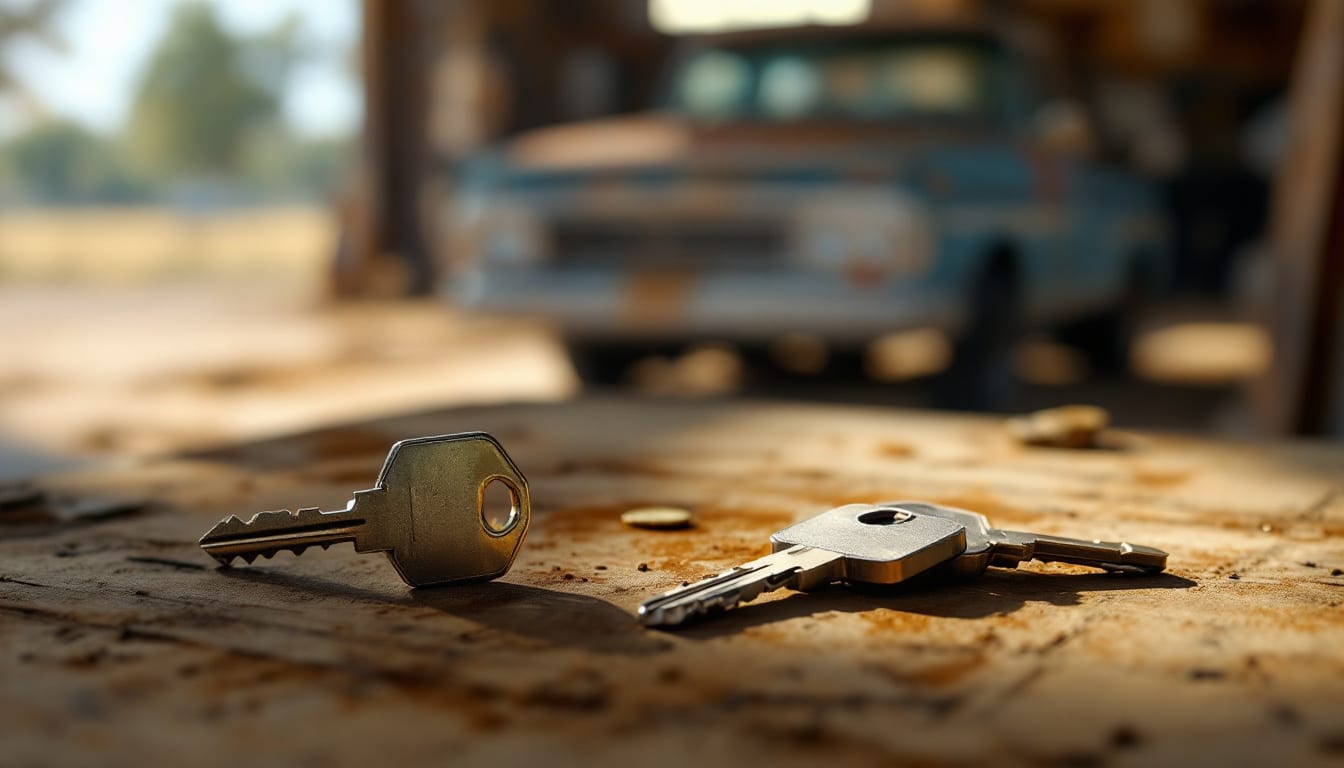
Hood County is full of these trucks and they are not going anywhere. A 1986 F-150 that still pulls a stock trailer, a 1994 Bronco that has never left the family, an F-250 that lives at the back of a property and starts on the third crank. The key situation on all of them was settled decades ago by somebody who is no longer around. Call or text (817) 214-2934 and we will bring a new one to the truck.
Quick Answer
As of September 2026, a key for a 1980–1996 Ford F-Series or Bronco is one of the cheapest keys we cut, because there is no chip involved. Duplicating a working key runs $75–$125. Originating a key with nothing that works — reading a lock and cutting to it — runs $100–$300. If the ignition cylinder itself is worn out or seized, replacement lands in the $150–$350 ignition band. The complication on these trucks is not electronics. It is that Ford used two different keys in this era, and that thirty-plus years of cylinder swaps mean the key in your hand may not match anything on the truck.
No Chip: What That Means for You
Ford's PATS transponder system arrived on the Mustang in the mid-1990s and worked its way across the lineup over the following years; the F-Series did not get it until the tail end of the decade, on the truck that replaced this one. The Bronco ended production in 1996 without ever carrying it.
So for the whole 1980–1996 window — Bullnose, Bricknose, and the OBS trucks — the key is pure metal. Nothing to program, nothing to pair, no immobilizer to satisfy, no module to talk to.
Practically, that means three things:
A key can be made anywhere the lock can be reached. Barn, pasture, storage lot, the far side of a field in Tolar. There is no reason to move the truck.
All-keys-lost is not the disaster it is on a modern vehicle. On something newer, losing every key means immobilizer work — the situation we describe in our lost car key with no spare guide and, at the module level, in our transponder key guide for Granbury. Here it means reading a lock.
A hardware-store copy usually does work — with one caveat covered below, and with the understanding that a copy of a copy of a copy is how ignition cylinders die.
If your truck is from the generation after this one, the story changes completely; the chip era is what our F-150 2015–2020 spare key post covers.
The Two-Key System Is the Real Story
Through this era Ford, like most manufacturers of the time, gave you two keys with different jobs: one for the ignition, and a different one for the doors and tailgate. They are cut on different keyways, which means they are not interchangeable and never were.
This is where thirty years of history bites people:
The keys drift apart. A door cylinder replaced in 1998, an ignition swapped from a donor truck in 2004, a tailgate handle from a swap meet. By now a lot of these trucks have three unrelated locks and one key that operates one of them.
The key you have may be for the wrong lock. The single most common thing we hear is "I have a key but it does not start it." Very often that is the door key, and it has never started the truck in its life.
One key for everything usually means new cylinders. Because the two keyways are physically different, matching every lock to a single key generally means changing hardware rather than just rekeying. That is a legitimate thing to want on a restored truck — it is just a hardware conversation, not a cutting conversation, and we will price it at the vehicle instead of over the phone.
If you have a GM truck from the same era, the arrangement is different and the pitfalls are different; we covered that separately in our 1988–1998 Chevy C/K and Suburban key post.
Granbury Pricing
| Job | Typical Granbury range (September 2026) | Notes |
|---|---|---|
| Duplicate a working key (ignition or door) | $75–$125 | Cheapest job on the truck |
| Originate a key by reading a lock | $100–$300 | The usual "nothing works" job |
| Originate ignition and door keys on one visit | $100–$300 range, quoted together | Cheaper than two separate calls |
| Broken key extracted from a lock or ignition | Low end of $75–$350, quoted on findings | Depends whether the cylinder survives |
| Ignition cylinder repair or replacement | $150–$350 | Includes cutting a key to the new cylinder |
| Door, tailgate, or toolbox cylinders rekeyed | $50–$150 per lock | Standard rekey band |
Those are the ranges we publish across the site — see our auto locksmith services and costs guide — and the number is agreed before we start. Dealer pricing is largely not a comparison here: these trucks are decades out of support, blanks are not on the shelf, and key codes generally are not retrievable from the manufacturer that far back. On the newer trucks a dealer still services, key work commonly starts at $200–$600 and requires the vehicle on their lot — the comparison we lay out in our dealer cost comparison post.
How a Key Gets Made With Nothing to Copy
There is no VIN-to-key-code lookup you can rely on for a truck this old. The code either was never in a retrievable database or has long since aged out. So the cut comes off the truck itself.
Decode a lock. Door cylinders are the usual candidate — they are easier to reach than an ignition buried in a column that may already have been apart once. The wafer stack is read and the cut derived from it.
Cut and test. Cut, try it, adjust. On worn locks the first cut is a starting point, not a finish line.
Confirm which lock you actually got. Because of the two-key system, a key decoded from a door will not start the truck. If you need both, say so at booking so we plan for both.
Some of these trucks still carry the original key code stamped on a lock cylinder or the factory key tag in a glovebox envelope somebody never threw away. If you have that envelope, it is worth ten seconds of looking — it can shorten the job.
The Ignition Cylinder Is Usually the Thing That Actually Fails
By this age, the complaint "my key does not work" is more often a worn lock than a worn key.
The pattern is predictable. A key that is a copy of a copy is slightly off. Every insertion wears the wafers a fraction. Eventually the cylinder no longer indexes — the key needs jiggling, then lifting, then a particular angle, then it stops entirely, usually on the coldest or hottest morning of the year.
Symptoms in the order we hear them:
It only works if you wiggle it. Early stage. This is the moment to replace the key, before it costs you a cylinder.
It turns to accessory but not to start. Wear or a partially failed cylinder.
The key spins freely and nothing happens. Mechanical failure inside the cylinder, or a failed connection at the back of it.
The key will not go in at all. Debris, a bent key, or corrosion. We walk the full sequence in our key won't turn in the ignition guide.
Do not force it. A thirty-year-old steel key is fatigued, and your wrist can generate far more torque than it can take. The most expensive version of this problem is a snapped key in a seized cylinder.
Replacing the cylinder on these trucks is well-understood work, and it comes with a key cut and tested to the new lock. It is the same $150–$350 band we publish for ignition repair, and the same job we do on the heavier trucks in our Ford Super Duty ignition repair post.
Where These Trucks Actually Are
The reason this is a mobile job rather than a shop job is that these trucks mostly do not go anywhere.
We key them in pastures, in equipment barns, behind shops, at storage lots, on trailers, and in driveways off caliche roads all over Hood County. The truck does not have to run. It does not have to be registered. It does not have to have a battery in it — a key cut from a decoded lock can be tested mechanically. What it does have to be is yours, and we will ask for proof of that before originating anything: title, bill of sale, insurance, or matching ID at the address the truck lives at. Any locksmith who skips that step on a farm truck is one you should not call again — see our how to vet a locksmith post.
Distance is real out here, and we are honest about it in our Hood County response time and rural coverage post. Granbury, Acton, DeCordova, Pecan Plantation, Tolar, Lipan, Cresson, Nemo, Bluff Dale, Glen Rose, and roughly 25 miles out.
What We Need Before We Come Out
Year and body. 1980–86, 87–91, and 92–96 are three different trucks under the sheet metal from a lock standpoint, and a Bronco is not identical to an F-150.
What currently works. A key that opens the door but will not start it? A key that starts it but will not open the door? Nothing? Each is a different quote.
Whether the truck has been apart. A replaced ignition, a swapped column, a donor door — all normal on a truck this age, all worth knowing in advance.
Whether you want everything matched. Because of the two-key system, this is a hardware decision, and it is worth planning as one visit.
Proof of ownership.
Two Habits That Keep This Cheap
Replace a worn key before it wears the lock. A $75–$125 key cut at the first sign of jiggling is how you avoid a $150–$350 cylinder later. That is the single highest-return maintenance item on an old truck's lock system.
Cut a spare while we are already there. These trucks outlive everything, including the person who knew where the second key was. On modern vehicles we make the same argument in our spare car key post — and the newer trucks in the driveway, like the ones in our 2014–2018 Silverado transponder key and remote start post, cost several times more to key from scratch than this one does.
Frequently Asked Questions
Does a 1980–1996 Ford F-150 or Bronco key have a chip in it? No. Ford's PATS transponder system did not reach the F-Series until the end of the 1990s, and the Bronco ended in 1996 without it. Anything in this window is a purely mechanical key — no programming required.
How much does a key for an old Ford truck cost in Granbury? As of September 2026, $75–$125 to duplicate a working key and $100–$300 to originate one by reading a lock. Ignition cylinder repair or replacement is $150–$350. The number is quoted before work starts.
I have a key but it will not start the truck. Why? Most likely you have the door key. Ford used two different keys in this era — one for the ignition, a different one for the doors and tailgate — on two different keyways. It is also possible the ignition was replaced at some point and no longer matches anything else.
Can you make a key from the VIN on a 1980s Ford? Generally no. Key codes for vehicles that old are usually not retrievable, so the cut is derived from the truck's own locks instead. Any shop that promises a VIN-based cut on a truck this age is guessing.
Can I get one key that opens the doors and starts the truck? Usually only by changing cylinders, because the ignition and door keyways are physically different. It is a normal request on a restored truck — it is just hardware work, and we price it at the vehicle after seeing what is installed.
Will you come to a barn, a pasture, or a storage lot? Yes. That is most of this work. The truck does not need to run, be registered, or even have a battery — but you do need to show it is yours before we originate a key.
My key snapped off in the ignition. Is the cylinder ruined? Not necessarily. If the key broke because the metal was fatigued in an otherwise healthy lock, extraction is usually clean. If it broke because the cylinder was seized, the cylinder is generally the problem and replacement runs $150–$350.
Get a Number Before You Start Pulling the Column Apart
If an old Ford is sitting because of a key, call or text (817) 214-2934 with the year, whether it is an F-Series or a Bronco, and what currently turns. Weekdays 8:00 AM to 7:00 PM, Saturdays 8:00 AM to 5:00 PM, with 24/7 emergency availability. You can also request service through our contact page or read how car key replacement in Granbury works.