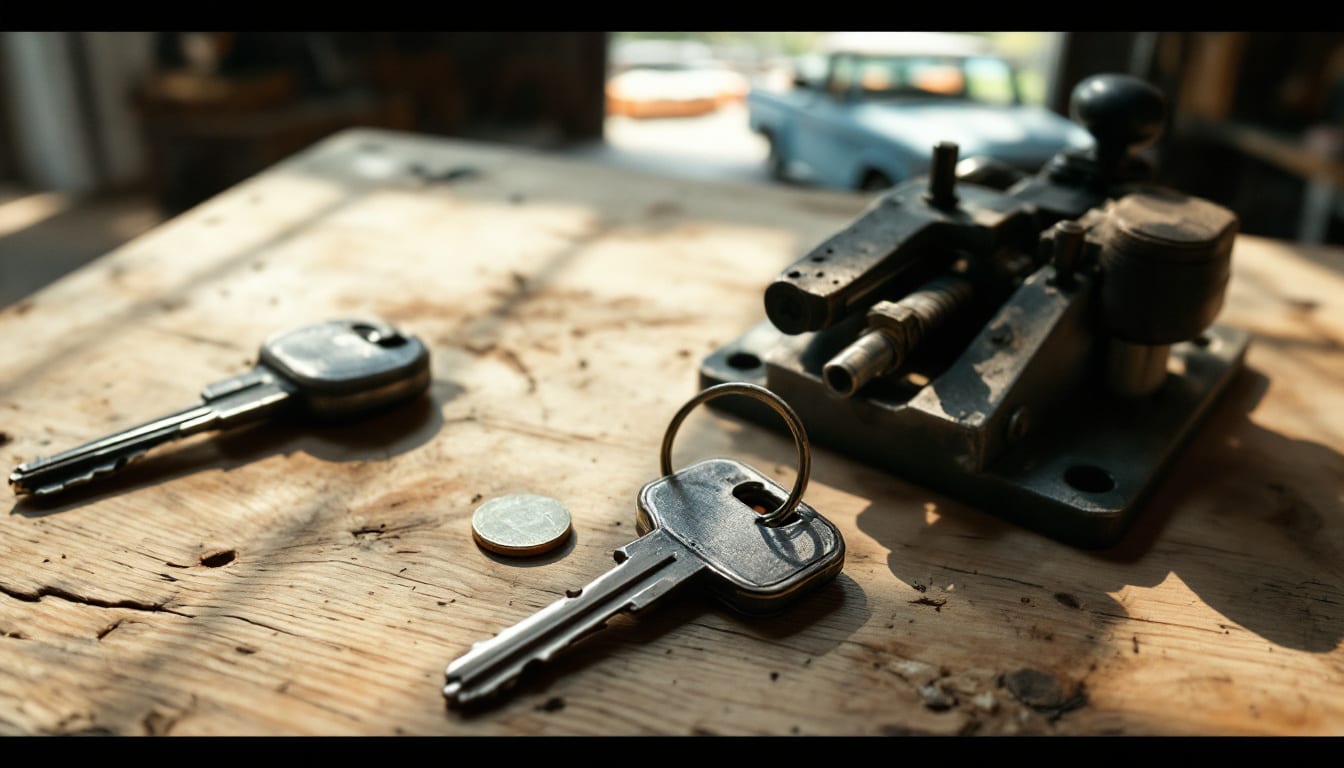
Old vehicles are the ones people actually keep. A 1972 pickup that still hauls hay, a 1988 Suburban that has pulled the same boat to Lake Granbury for thirty summers, a restored Chevelle that comes out on clear Saturdays. What they have in common is that the key situation was handled decades ago by somebody who is no longer around, and nobody has thought about it since. Call or text (817) 214-2934 and we will bring a new one to the vehicle.
Quick Answer
As of October 2026 in Granbury, a duplicate mechanical key for a pre-transponder classic runs $75–$125, and originating a key with no working original — decoding a lock, cutting, and testing — generally runs $100–$300. If the ignition cylinder itself is worn out or seized, cylinder repair or replacement is typically $150–$350. Older vehicles are usually the cheapest keys we make, because there is no chip to program. The cost sits in the lock work, not the key.
Why Classic Keys Are a Different Job
Modern key replacement is mostly a software problem. A newer vehicle has a VIN, the VIN produces a key code, the code produces a cut, and a chip gets written into the immobilizer. The mechanical part is almost incidental.
On a pre-transponder vehicle almost none of that applies.
There is often no VIN-to-key-code lookup. For a lot of vehicles built before the early 1990s, the manufacturer's key-code records either were never digitized or no longer cover the vehicle. There is nothing to look up. The code has to come off the vehicle itself.
The lock is the source of truth. A door lock, glovebox lock, or ignition cylinder can be removed and decoded, or read in place with the right tooling, and the cut derived from the actual wafer stack. That is a mechanical process, and it takes as long as it takes.
Decades of wear are in the way. A lock that has been cycled tens of thousands of times, in Texas heat, with a key that is itself a copy of a copy, does not decode cleanly. Sometimes the honest answer after decoding is that the cylinder is past saving.
Original keys are frequently the wrong keys. The single most common thing we find on an older vehicle is that the key in the owner's hand is not the key the vehicle left the factory with. Somebody had a cylinder replaced in 1996, or swapped an ignition from a donor truck, and now the door key and the ignition key are two different keys nobody wrote down.
None of that is a problem. It just means the work happens at the vehicle, by hand, and it is priced by what the locks need.
Granbury Pricing
| Job | Typical Granbury range (October 2026) | Notes |
|---|---|---|
| Duplicate a working mechanical key | $75–$125 | Fastest and cheapest job we do |
| Originate a key with no working original | $100–$300 | Decode a lock, cut, test |
| GM resistor-pellet key, duplicated | $75–$125 | Blade cut plus the correct resistor value |
| GM resistor-pellet key, none working | $100–$300 | Value determined at the vehicle, then cut and tested |
| Broken key extracted from a lock or ignition | Low end of our $75–$350 range | Priced on damage found, quoted first |
| Ignition cylinder repair or replacement | $150–$350 | Includes cutting a key to the new cylinder |
| Door, glovebox, or trunk locks rekeyed to one key | Quoted per vehicle | Depends how many cylinders you want matched |
| Vehicle unlocked, keys visible inside | From $50–$75 | See car lockout service |
Dealer pricing is not a useful comparison on most of these vehicles, because the dealer no longer supports them at all — there is no blank on the shelf and no code in the system. On the vehicles a dealer will still touch, key work commonly starts at $200–$600 and requires the vehicle on their lot. Mobile locksmith pricing in Hood County typically runs 40–60% below dealer for equivalent work. The broader picture is in our dealer cost comparison and our auto locksmith services and costs guide.
What Actually Changes the Price
Six things move a classic-key quote, and none of them are the year on the title.
Whether any key still turns anything. One working key of any kind — even a door key, even a badly worn one — is the difference between a $75–$125 duplication and a $100–$300 origination. If you have a key that works in one lock on the vehicle, say so when you call.
Whether a lock has to come off. Decoding in place is faster than removing a cylinder, and pulling a door cylinder on an 80s truck is faster than pulling an ignition out of a steering column that has already been apart once.
Blank availability. Common domestic blanks from the 1960s through the 1990s are stocked and cheap. Some imports, some early luxury cars, and a handful of aftermarket cylinders are not, and the blank has to be sourced before we come out. That is usually a scheduling question rather than a price question — but tell us the make and year early so we bring the right stock.
Whether the vehicle has an anti-theft system. Most pre-1996 vehicles have nothing at all. Some GM cars from 1986 onward have a resistor pellet in the key blade, which adds a step. Vehicles from the late 1990s forward increasingly do carry a chip, and that becomes a different job — see our transponder key guide for Granbury if your vehicle sits on that side of the line, or the transponder vs smart key vs fob breakdown if you are not sure which you have.
Condition of the cylinder. A cylinder with collapsed wafers cannot hold a good key no matter how well the key is cut. Cutting a perfect key to a dead lock is money spent twice.
How many locks you want matched. Owners of restored vehicles often want one key for everything — doors, ignition, glovebox, trunk. That is a rekey job stacked on top of a key job, and it is worth pricing as one visit rather than three separate calls.
GM Resistor Keys: the pellet in the blade
This is the piece of 1980s and 1990s technology that surprises people most, so it is worth being precise about.
Beginning with the 1986 Corvette and spreading through the Camaro, Firebird, and several full-size GM cars into the 1990s, General Motors built a small resistor pellet into the plastic body of the key blade — the system commonly called VATS or PASS-Key. The ignition lock reads the resistance value when the key goes in. If the value does not match what the module expects, the vehicle cranks and will not run, or will not crank at all, depending on the generation.
Three practical consequences:
The key is not a chip. There is no radio, no battery, and nothing to "program" the way a modern transponder is programmed. There is a fixed set of possible resistance values and the vehicle expects exactly one of them.
A hardware-store copy will fail. A blank cut on a duplicating machine with no pellet, or with the wrong pellet, produces a key that opens the doors and will not start the engine. This is the most common complaint we hear on these cars, and it is not a bad cut — it is the wrong resistor.
With no working key at all, the value has to be determined at the vehicle. That is routine work with the right meter and blanks, but it is work, which is why the no-working-key band is higher.
We have since written the pellet-key job up on its own page, including how to tell a worn key from worn cylinder contacts or broken wires in a tilt column: GM VATS key replacement cost in Granbury.
GM's light trucks of the same era mostly went a different route — a sensor built into the lock cylinder rather than anything in the key. If you have an 80s or 90s Chevy or GMC pickup or Suburban, read our C/K 1500 and Suburban key guide, because on those trucks the key itself is usually the cheap part.
The Ignition Cylinder Is Usually the Real Story
On a vehicle with three hundred thousand miles and forty years behind it, we get called for a key and we find a lock.
The failure pattern is consistent. Brass wafers wear down against a steel key. A worn key wears the wafers further. Eventually the two worn parts only agree with each other, in one position, at one angle. Then that key gets copied, the copy does not carry the original wear pattern, and nothing works.
Symptoms that point at the cylinder rather than the key:
- The key has to be jiggled, lifted, or pulled back slightly to turn
- The key turns freely with no resistance, as if it is not engaging anything
- The key goes in partway and stops
- It works cold in the morning and not in the afternoon
- A brand-new, correctly cut key is worse than the old worn one
That last one is the giveaway, and it is counterintuitive enough that people assume the new key was cut wrong. It usually was not. The new key is correct and the lock is not.
If your key will not turn at all, we wrote a separate walkthrough: key won't turn in the ignition on an older vehicle. Cylinder work itself is covered on our ignition repair page, and the cost side is compared in ignition switch repair: locksmith vs dealer. For older vehicles specifically, where the choice is between rebuilding the original cylinder and fitting a new one set to your existing key, see the classic car ignition repair cost guide.
What We Need Before We Come Out
- Year, make, model, and body style. "A 1990s Chevy" is not enough to pick blanks. A truck, a car, and a van from the same year can take three different keys.
- Proof of ownership. Title, registration, or insurance in your name plus matching photo ID. On an unregistered project car, bring the title. Texas locksmiths operate under the Texas Department of Public Safety Private Security Program, and verifying ownership before originating a key is required, not optional.
- An honest key inventory. Does anything turn? Doors, glovebox, trunk, ignition — each one is a data point, and a key that works in any of them shortens the job and lowers the price.
- Whether the ignition has ever been replaced. A donor column or a parts-store cylinder means the vehicle now carries two or more key patterns. Knowing that in advance prevents a wasted trip.
- A precise location. Barn, shop, pasture, storage unit, driveway, or a cross street. Rural addressing is what makes arrivals late in Hood County, not distance — the detail is in our response-time guide.
How the Job Runs on an Older Vehicle
Assessment. We look at what turns and what does not before touching anything, because that decides whether this is a key job or a lock job.
Decode. A lock is read in place or removed and decoded to produce the cut specification. On a vehicle that still carries a code tag or a stamped cylinder, that step is faster.
Cut. The blade is cut mechanically. On a GM car with a resistor pellet, the correct value is fitted and verified.
Test every lock. Doors, ignition, glovebox, trunk, tailgate. We want to know now which cylinders agree with the new key and which do not, because that is the difference between one key and a keyring.
Recommend rather than upsell. If a cylinder is dying we say so and quote it. If it has years left, we say that too. Cutting a good key to a bad lock is the outcome nobody wants.
Typical time on site is 30 to 90 minutes for straightforward mechanical work, longer if a cylinder has to come out of a steering column.
Two Habits That Prevent the Expensive Version
Make the spare while a key still works. Duplication is $75–$125. Origination with nothing working is $100–$300 and can turn into cylinder work on top. The vehicles most likely to be sitting on one worn key are the ones where a second key costs the least.
Stop copying the copy. Each generation of duplicate drifts a little further from the original specification. If your current key is already a copy of a copy, ask for a key cut to the lock rather than traced off the worn one. It costs the same and it lands on the actual specification instead of on forty years of accumulated error.
For a broader look at what to do the day a key disappears, see what to do if you lost your car key and can a locksmith make a car key without the original.
Frequently Asked Questions
Can you make a key for a car with no key code on record? Yes. On older vehicles we derive the cut from the vehicle's own locks — decoding a cylinder or reading it in place — rather than from a manufacturer database. That is the normal method on pre-1990s vehicles, and it is why the no-working-key band runs $100–$300 rather than the $75–$125 duplication price.
How much does a key for a classic car cost in Granbury? As of October 2026, $75–$125 to duplicate a key that still works, and $100–$300 to originate one with nothing working. Ignition cylinder repair or replacement, if the lock is worn out, runs $150–$350. You get the number before we start.
Why does my new key open the doors but not start the car? On a GM vehicle with a resistor pellet in the blade, that is the classic symptom of a blank cut without the pellet or with the wrong value. On other vehicles it usually means the ignition cylinder was replaced at some point and no longer matches the door locks.
Can you cut a key from the VIN on a 1970s vehicle? Usually not, and any shop that promises it on a vehicle that old is guessing. VIN-based key codes generally are not available that far back. We read the vehicle's own locks instead.
Can you make one key work every lock on my restored car? Often yes. Doors, glovebox, and trunk cylinders can frequently be rekeyed to match a single key, and matching them in one visit is far cheaper than separate calls. See car lock rekey for how that service works.
Do you carry blanks for older vehicles? We stock the common domestic blanks from the 1960s through the 1990s. Uncommon imports and some aftermarket cylinders need to be sourced first, so give us the year, make, model, and body style when you call.
Will you come out to a barn or a storage unit? Yes. Barns, shops, storage units, pastures, and trailers are normal calls across Hood County. The vehicle does not need to run or be registered — but you do need to show ownership.
Get a Number Before You Start Pulling Parts
If you have an older vehicle with a key problem in Granbury, call or text (817) 214-2934 with the year, make, model, and what currently turns. Serving Granbury, Acton, DeCordova, Pecan Plantation, Tolar, Lipan, Cresson, Nemo, Bluff Dale, Glen Rose, and 25 miles out. Weekdays 8:00 AM to 7:00 PM, Saturdays 8:00 AM to 5:00 PM, with 24/7 emergency availability. You can also request service through our contact page or read more about car key replacement in Granbury.
Sources
- Texas Department of Public Safety — Private Security Program
- Associated Locksmiths of America
- National Automotive Service Task Force — Vehicle Security Professional Program
- National Highway Traffic Safety Administration — Vehicle Theft Prevention
- Federal Trade Commission — How to Find a Good Auto Repair Shop