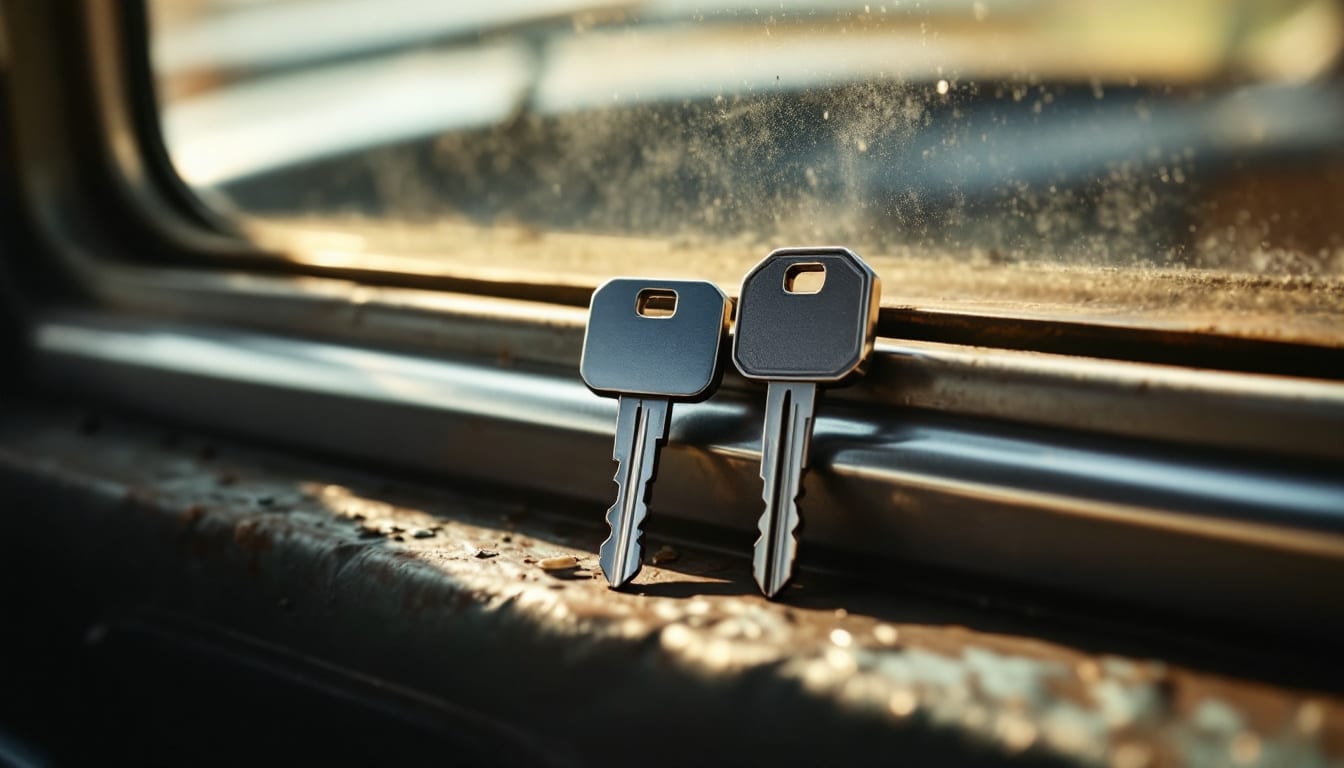
The most common thing we hear about a classic car in Hood County is not "I lost the key." It is "I have four keys and I am not sure which one does what." Call or text (817) 214-2934 and we will tell you which of those cylinders can be brought onto one key and which one is going to argue.
Quick Answer
As of September 2026 in Granbury, bringing a classic car's locks onto a single key is quoted per vehicle rather than as a flat price, because the number of cylinders and their condition is what does the work. The pieces that do have ranges: cutting a key to an existing cylinder runs $75–$125, originating a key when nothing works runs $100–$300, and ignition cylinder repair or replacement runs $150–$350 including a key cut to the new cylinder. A typical four-cylinder job — ignition, two doors, trunk — is quoted after we see how worn the wafers are, and worn wafers are the single biggest variable on a car this age.
Why Your Classic Came With Two Keys in the First Place
This surprises people who grew up with one key per car. For decades, most American manufacturers deliberately issued two keys with a new vehicle, and they were not spares of each other.
General Motors is the clearest example. Into the 1990s, GM issued a square-headed key that operated the ignition and the doors, and a round or oval-headed key that operated the trunk and the glovebox. The logic was valet parking: you handed over the square key so somebody could drive and lock the car, and you kept the round key so they could not get into your luggage or your glovebox. Ford and Chrysler ran variations of the same idea across different eras.
So if you have a 1972 Chevelle with two different-looking keys, nothing is wrong. That is the factory design. The question is only whether you still want it that way, and most owners of a car they actually drive to the Granbury square on a Saturday do not.
Then sixty years happen. A door lock seizes and somebody fits a cylinder from a swap meet. A trunk lock gets drilled after a lost key. An ignition gets replaced with a universal from a parts store. Each of those events adds a key. A car that left the factory needing two keys very commonly arrives with four or five, none of which are original, and at least one of which nobody can identify.
What "Keying Alike" Actually Means on a Vintage Car
There are two genuinely different jobs here, and the price difference between them is large.
Rekeying means opening the existing cylinder, removing the wafer tumblers, and reordering or substituting them so that cylinder accepts a different key. The cylinder you started with is the cylinder you keep. On a car where originality matters — a numbers-matching restoration, a car with correct date-coded hardware, a car where the bezel or escutcheon is not reproduced — this is almost always the right answer, and it is the answer collectors ask for.
Replacing means fitting a new or new-old-stock cylinder that is already cut to a code, and then either matching everything else to it or cutting one key to the code. Faster, sometimes cheaper on a single lock, and the wrong call if the part you are removing is unobtainable.
On most classic American cars the lock internals are wafer tumblers — flat brass plates that rise into a shear line, rather than the round pin tumblers in your house locks. Wafers are simple, which is good news: there is real depth of adjustment available, and a competent locksmith can bring several cylinders onto one key without exotic parts. Wafers are also thin, which is the bad news: after five or six decades of a key being jiggled in and out, they wear, and a worn wafer set will accept keys it should reject and eventually accept nothing at all.
What This Costs in Granbury
| Job | Typical Granbury range (September 2026) | Notes |
|---|---|---|
| Cut a key to a cylinder that already works | $75–$125 | Fastest and cheapest job on the list |
| Originate a key with nothing working | $100–$300 | Decode the cylinder, cut, test |
| Ignition cylinder repair or replacement | $150–$350 | Includes a key cut to the new cylinder |
| Rekey door, glovebox or trunk cylinders to one key | Quoted per vehicle | Priced on cylinder count and wafer condition |
| GM square-key and round-key sets brought onto one key | Quoted per vehicle | Ignition, doors, trunk, glovebox as one set |
| Broken key extracted from a lock or ignition | Low end of our $75–$350 range | Quoted after we see the break |
| Vehicle unlocked with keys visible inside | From $50–$75 | See car lockout service |
| Mobile service anywhere inside our 25-mile radius | Included in the quote | No separate trip or call-out fee |
Those bands are the same ones published across this site, including on our classic car key replacement cost guide and our lock rekey service page. The multi-cylinder work is quoted per vehicle on purpose. We are not going to publish a flat number for "rekey a classic" when the honest answer is that a 1965 Mustang with four crisp original cylinders and a 1965 Mustang with four sloppy ones are different jobs, and pretending otherwise produces the mid-job price increase that everyone in this trade should have stopped doing years ago.
What Makes One Car Cheap and Another Expensive
In rough order of how much it moves the quote:
1. How many cylinders you actually want on the key. Ignition plus two doors is the common ask. Adding the trunk is usually easy. Adding a glovebox is usually trivial. Adding a locking gas cap, a toolbox, a console lid, or a tonneau latch each add a cylinder, and cylinders are the unit of work.
2. Wafer wear. This is the one nobody plans for. If the wafers in a door lock are worn past the point where they will hold a clean shear line, no amount of reordering fixes it — that cylinder needs internals replaced or the cylinder itself replaced. We can usually tell within a minute of pulling one apart, which is why we quote after inspection rather than over the phone.
3. Whether the cylinders are original to each other. A car whose four cylinders are all factory GM of the same era can very often be brought onto one key with parts we carry. A car with one GM cylinder, one universal parts-store cylinder, and one mystery cylinder from a donor car is three separate problems that happen to be bolted to the same vehicle.
4. Access. Some door cylinders come out from behind a trim panel in five minutes. Some require pulling the door card, dropping the glass, and working blind through a hole designed for a smaller hand than anyone has. On cars with brittle sixty-year-old plastic clips, careful is slower, and slower is what protects the trim you cannot replace.
5. Whether a code exists. Many classic locks carry a code stamped on the cylinder body, and original owner's packets often included a key code tag. If a code is present and legible, several steps collapse into one. If you still have the original packet or the dealer envelope in the glovebox, bring it out — that little tag is worth money.
The Case for Rekeying Rather Than Replacing
A lot of well-meaning advice online says to just buy a new lock set. On a daily driver, fair enough. On a car you are keeping, three reasons to think again.
Originality has value. Date-coded and correctly-stamped hardware is part of what a judged car is judged on. A reproduction cylinder with a modern keyway is visible to anyone who looks, and once the original is drilled it is gone.
Reproduction quality is uneven. Some reproduction cylinders for popular platforms are excellent. Others are soft, and a soft wafer stack wears in a season. Rekeying a good original often outlasts fitting a mediocre new one.
Bezels and escutcheons are frequently the real obstacle. On a fair number of platforms the cylinder is available and the trim ring around it is not. Removing a seized cylinder without destroying the trim is the skill that matters, and it is the reason to have someone do this who has done it on that generation of car before.
When One Key for Everything Is the Wrong Choice
Worth saying plainly, because we talk owners out of this a few times a year.
If the car is stored somewhere with shared access, or shown with the trunk open, or driven by more than one household, the original two-key split still has a point. Keeping the trunk and glovebox on a separate key means the person who parks the car cannot open the compartment where the title, the tools and the paperwork live. That is exactly why GM did it.
And if the ignition is the one cylinder you plan to replace soon anyway, do the rekey after the new ignition is in, not before. Otherwise you pay to bring four cylinders onto a key and then change the one that mattered.
Vintage Locks Are Not Vehicle Security
One honest note, because we would rather say it than let a customer assume otherwise.
Bringing a classic's locks onto one key is a convenience and originality job. It is not a theft-prevention upgrade. Wafer locks of this era were never designed against modern attack, and a vehicle from before the mid-1990s generally has no immobilizer of any kind — the engine does not care who turns the key. Federal theft-protection standards under FMVSS 114 brought in key-locking and rollaway requirements over time, and the electronic immobilizers most drivers now take for granted arrived on mass-market vehicles much later than the cars we are discussing here.
For a vehicle you care about, the meaningful protections are the boring ones: a battery disconnect or hidden cut-off, a wheel or steering lock, a covered and monitored place to keep it, a proper agreed-value insurance policy, and photographs plus VIN records filed somewhere that is not the glovebox. The National Insurance Crime Bureau publishes owner resources on theft prevention and on what to have documented before anything happens, and for a collector vehicle the documentation is the part most owners skip.
What We Need Before We Come Out
Photographs get you a far better answer than a description. Text these to (817) 214-2934:
- Year, make and model, and whether the car is original or has had a restoration.
- Every key you have, laid out side by side, heads visible. The head shape tells us the era and the series.
- Each lock face you want on the key — ignition, both doors, trunk, glovebox, anything else.
- Which keys currently work in which locks. Even partial information ("this one does the doors but not the trunk") saves a step.
- Any code tag, dealer envelope, or original packet you still have.
- Where the car is and whether it currently drives or is going to be worked on where it sits. We come to you anywhere in our 25-mile radius, and for a vehicle that does not run that is usually the only sane option.
How the Visit Runs
We start by reading what you already have. Every key gets checked against every lock so we know the real starting point, which is frequently not the one the owner described.
Then cylinders come out, one at a time, and each gets opened and inspected. This is the point where the quote firms up, because wafer condition is now visible rather than guessed. If something is worn past rekeying we tell you then, with the option to replace that one cylinder or leave it on its own key.
Then the set gets brought onto a common code, cut, and — the part that actually matters — tested in place, repeatedly, with the panels back on. A lock that works on the bench and binds once the door card is back is a lock that is not finished. You leave with keys that have been turned in every cylinder more than once.
One Habit That Saves the Expensive Version
Once you have one key that does everything, have a second one cut the same day and put it somewhere that is not the car.
The reason is arithmetic rather than advice. Cutting a duplicate to a cylinder that works sits at the bottom of the $75–$125 band. Originating a key for a classic with nothing working sits in the $100–$300 band, takes longer, and on a worn cylinder occasionally turns into cylinder work as well. The spare is the cheapest thing on this page and it is the one people skip.
Keep it flat, keep it dry, and do not keep it in a magnetic box under the car — that is the first place anyone looks, and on a vehicle with no immobilizer it is the whole security system.
Frequently Asked Questions
How much does it cost to rekey a classic car's locks to one key in Granbury? It is quoted per vehicle, because cylinder count and wafer condition drive the work. The components with published ranges are cutting a key to a working cylinder at $75–$125, originating a key with nothing working at $100–$300, and ignition cylinder repair or replacement at $150–$350. We inspect, quote, and then work — the number does not move mid-job.
Why does my classic have two different keys? That is almost certainly factory. GM and others issued a square-headed key for the ignition and doors and a round or oval-headed key for the trunk and glovebox, so a valet could drive and lock the car without getting into your belongings. It is a design decision, not a fault, and it can be consolidated onto one key if you prefer.
Can you rekey the original cylinders instead of replacing them? Usually yes, and on a car where originality matters that is what we recommend. Wafer tumblers give real adjustment range. The exception is a cylinder worn past holding a clean shear line — no reordering fixes that, and we will tell you when we see it rather than after you have paid for it.
Will rekeying make my classic car harder to steal? No, and we would rather be straight about that. This is a convenience and originality job. A pre-1990s vehicle generally has no immobilizer at all, so the engine does not check who turned the key. If theft is your concern, a hidden battery cut-off, a physical steering or wheel lock, secure storage and proper agreed-value insurance do far more than any lock cylinder.
Do you come to me, or does the car have to be brought in? We come to you. Mobile service anywhere inside 25 miles of Granbury is included in the quote, with no separate trip fee — Acton, DeCordova, Pecan Plantation, Tolar, Lipan, Cresson, Nemo, Bluff Dale, Glen Rose and out to the county lines. For a car that does not currently run, mobile is the only route that does not involve a trailer.
What if a lock has already been drilled? Then that cylinder is a replacement rather than a rekey, and we will say so up front. The rest of the set can still be brought onto one key, and the replacement gets cut to match. The part worth checking early is whether the trim ring around that lock is still available for your platform, because that is more often the obstacle than the cylinder itself.
How long does the job take? A single cylinder is usually under an hour. A four-cylinder set on a car with reasonable access is commonly a two to three hour visit. Access is the variable, not the lock work — a door that needs the card and the glass out takes as long as it takes, and rushing brittle sixty-year-old clips is how trim gets broken.
Can you make a key from a code stamped on the lock? Often yes, and it is the fastest path when a legible code exists. Check the cylinder face and body, and check any original dealer envelope or key tag that came with the car. If you have that tag, photograph it and send it before we come out.
Get a Real Number for Your Car
Send photographs of the keys you have and the locks you want on one key, and you will get a figure rather than a range. Call or text (817) 214-2934, weekdays 8:00 AM to 7:00 PM, Saturdays 8:00 AM to 5:00 PM, with 24/7 emergency availability. You can also request service through our contact page, read what key replacement on a classic costs, or see what to do when an older vehicle's key will not turn in the ignition.
Sources
- Texas Department of Public Safety — Private Security Program
- National Highway Traffic Safety Administration — Federal Motor Vehicle Safety Standards
- National Insurance Crime Bureau — vehicle theft prevention resources
- Texas Department of Motor Vehicles — titles and registration
- Associated Locksmiths of America
- National Automotive Service Task Force — Vehicle Security Professional Program