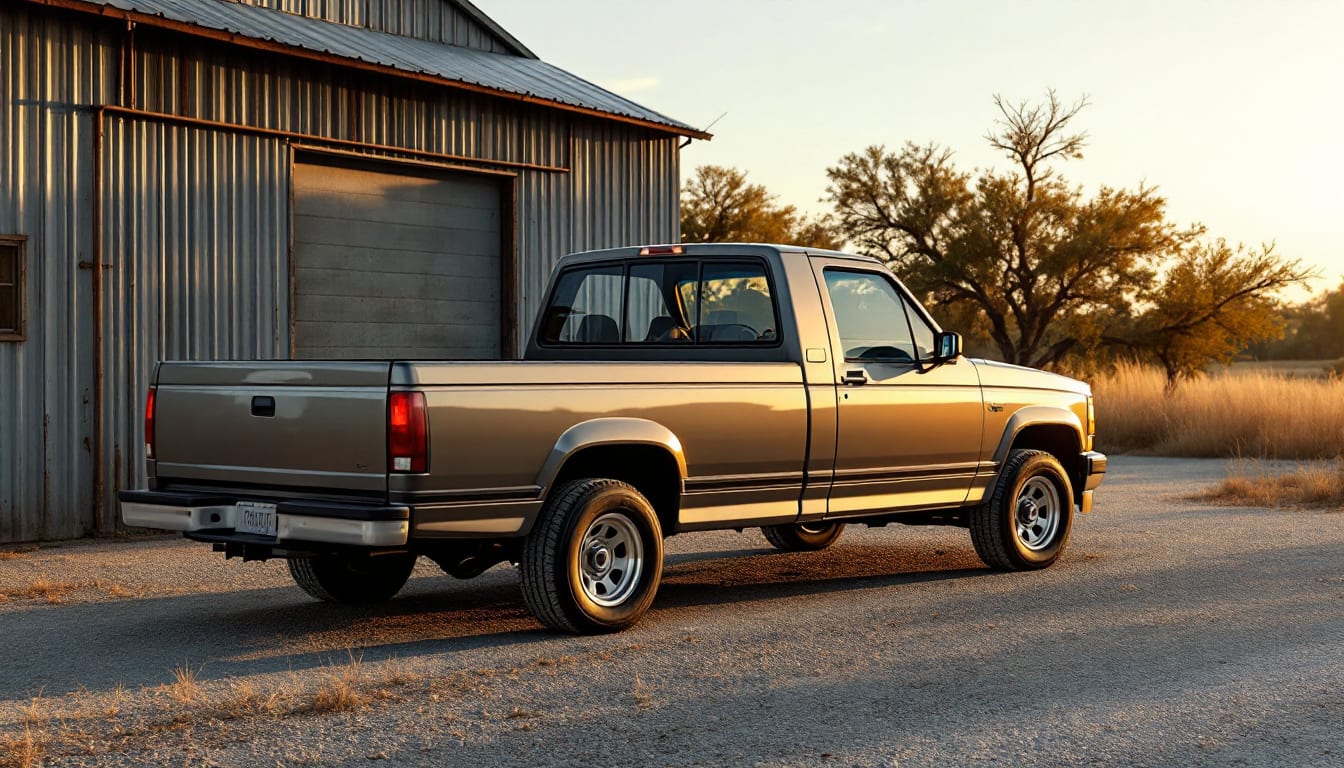
The GMT400 trucks — the C/K 1500, the Suburban, the first Tahoe and Yukon, built from 1988 through the late 1990s — are still working vehicles in Hood County, not museum pieces. They pull trailers, haul feed, and sit in barns between jobs. And they are old enough now that most of them are down to one key, cut from a key that was cut from a key. Call or text (817) 214-2934 and we will bring a new one to the truck.
Quick Answer
On a 1988–1998 Chevy or GMC full-size truck the key itself carries no transponder chip and no resistor pellet — it is a plain mechanical key, and duplicating one costs $75–$125 in Granbury as of October 2026. Originating a key with nothing working runs $100–$300, because the cut has to be decoded from a lock. The anti-theft on the later trucks of this generation is PassLock, which reads a sensor built into the ignition lock cylinder, not anything in your hand — so when one of these trucks refuses to start, the key is usually not the reason.
Why the Key Is the Cheap Part on These Trucks
This is the single most useful thing to know about the generation, and it saves people real money.
Through the 1990s, General Motors used several different anti-theft approaches on different vehicles at the same time:
Resistor keys on cars. Corvette, Camaro, Firebird, and various full-size cars got a resistor pellet embedded in the key blade — the system usually called VATS or PASS-Key. Those keys have a visible black or grey pellet in the metal, and a copy without the correct value opens the doors and will not start the engine. That is covered in our classic car key cost guide.
PassLock on the trucks. The full-size pickups and SUVs of this era went a different way. The security sensing lives inside the ignition lock cylinder, and the key stays a plain mechanical key with nothing electronic in it.
Transponder chips came later. Chipped keys arrived on GM trucks in the 2000s, not here. If your truck is newer than this generation, our Chevy and GMC transponder key guide and the transponder key overview for Granbury are the right pages, and the transponder vs smart key vs fob comparison will tell you which one you have.
The practical upshot: on a GMT400 truck you are buying a mechanical key, cut correctly, and nothing else. It is one of the least expensive keys we make.
If your truck is the generation before this one, with the squared-off body built from 1973 through 1987 and carried on as the Blazer and Suburban into 1991, the key is simpler still and the ignition column has its own habits. That truck has its own page: the square body Chevy and GMC key and ignition guide.
Granbury Pricing
| Job on a 1988–1998 C/K, Suburban, Tahoe, or Yukon | Typical Granbury range (October 2026) |
|---|---|
| Duplicate a key that still works | $75–$125 |
| Cut a key from a code found on a lock or code tag | $75–$125 |
| Originate a key by decoding a lock, nothing working | $100–$300 |
| Broken key extracted from a door, tailgate, or ignition | Low end of our $75–$350 range |
| Ignition lock cylinder replacement | $150–$350 |
| Doors, tailgate, and glovebox rekeyed to one key | Quoted per truck |
| Truck unlocked, keys inside | From $50–$75 |
A dealer will still make a key for one of these trucks in some cases, typically starting around $200–$600 with the truck on their lot — and there is no Chevrolet or GMC dealer inside Granbury, so an undrivable truck also means moving it out of the county. Mobile pricing here runs 40–60% below dealer for equivalent work. The full comparison is in our dealer cost breakdown.
Two Keys From The Factory, and Why It Matters
These trucks left the assembly line with two different key patterns: a primary key for the ignition and doors, and a secondary key for the glovebox and, on some configurations, other compartments. It was a deliberate design so a truck could be handed to somebody without handing over everything.
Thirty-plus years later, that design decision is the source of most of the confusion we walk into:
People assume one key should do everything and conclude something is broken when it does not. Frequently nothing is broken — that is how the truck was built.
One of the two patterns is almost always long gone. Usually the glovebox key. It has been missing since the Clinton administration.
Replacement cylinders scrambled the picture further. A door cylinder replaced in 2004, an ignition from a donor truck in 2011, and a tailgate handle from a swap meet mean the truck now carries three or four unrelated patterns.
That is a solvable problem and it is worth solving in one visit: decode what is there, cut what is missing, and rekey the odd cylinders so a single key runs the whole truck. Piecemeal, it is three or four service calls over a couple of years.
Making a Key With Nothing Working
The usual scenario on a truck this age is not "I lost my keys today." It is "we bought it at an estate sale," or "it has been in the barn since Dad passed," or "the only key broke off in the door in 2019."
Here is how that job actually runs.
Find a code first, if there is one. Some of these trucks still carry a code stamped on a lock cylinder body or on original documentation. A visible code is the fastest and cheapest path — we cut from it and test.
Otherwise decode a lock. A door cylinder or the glovebox lock is removed and decoded, producing the cut specification. Door and glovebox locks are far friendlier to work with than an ignition buried in a steering column, so that is where we start.
Cut and test in order. Doors first, then tailgate, then ignition. Testing in that sequence tells us immediately whether the truck still carries its original key pattern or whether somebody changed a cylinder along the way.
Handle the mismatches deliberately. If the ignition disagrees with the doors, you choose: carry two keys, or have the odd cylinder rekeyed to match so there is one key for everything. We quote both and you decide.
Typical time on site is 45 to 90 minutes. No tow, no dealership, and the truck does not need to be running or registered — but ownership has to be documented, which is the next section.
PassLock: The "Security" Light and the No-Start
If your truck is on the later side of this generation and it cranks but will not run, with a SECURITY telltale lit or flashing, that is not a key problem and a new key will not fix it.
What PassLock does: a sensor in the ignition lock cylinder reads the cylinder's rotation and sends a coded signal to the vehicle's control module. If the module does not receive the expected signal, fuel is cut and the truck cranks without starting.
What goes wrong, in rough order of frequency:
The sensor in the cylinder fails. It is a wear item on a truck with a quarter-million miles and a heavy keyring hanging off it.
Wiring at the column chafes. Small conductors, a moving column, decades of vibration.
The module loses its learned value after certain electrical work or a battery event.
There is a documented relearn procedure for these systems that some owners can perform themselves, and there is a hardware failure that no relearn will fix. Telling those two apart is the diagnosis, and it is worth doing before parts get bought. Our ignition repair page covers the cylinder side, and if the module itself is the problem, the general approach is the same one described in our immobilizer and module programming guide — a different make, the same class of fault.
One more thing worth stating plainly, because it comes up on these trucks constantly: a heavy keyring is a documented cause of ignition wear. A pound of keys, a fob, a bottle opener, and a trailer pin hanging off the cylinder is a lever working on the lock every time you go over a cattle guard. On a truck this old, that lever has been working for thirty years.
The Ignition Cylinder On a Thirty-Year-Old Truck
Symptoms that say the lock is worn rather than the key:
- The key has to be jiggled or lifted to turn
- It turns easily some mornings and not others
- A freshly cut, correct key is worse than the old worn one
- The key turns with no resistance and nothing happens
The last one on a GMT400 truck is often the lock's retainer or the actuator behind the cylinder rather than the wafers themselves.
If your key will not turn at all, we wrote the full walkthrough with the free tests first: key won't turn in the ignition on an older vehicle. And if you are weighing the repair against a dealer visit, ignition switch repair: locksmith vs dealer has the numbers.
Newer trucks in the same family have their own quirks worth knowing if you own more than one — see Silverado 1500 transponder and remote start (2014–2018) and Silverado push-to-start BCM relearn for the modern end of the lineup, or the 2500HD and 3500HD all-keys-lost guide for the heavy-duty side.
What We Need Before We Come Out
- Year and body style. A 1994 C1500 pickup, a 1994 Suburban, and a 1994 van are not the same job. "A 90s Chevy" is not enough to load the right blanks.
- Proof of ownership. Title, registration, or insurance in your name plus matching photo ID. On a barn find or an estate purchase, bring the title or the bill of sale. Texas locksmiths operate under the Texas Department of Public Safety Private Security Program, and ownership verification before originating a key is required.
- What currently turns. Driver door, passenger door, tailgate, glovebox, ignition — each answer shortens the job. A key that works in any one of them can change a $100–$300 origination into a $75–$125 duplication.
- Whether any cylinder has been replaced. If you know a door or ignition was changed at some point, say so.
- Whether the SECURITY light is on. That single detail moves this from a key job to a diagnosis, and we would rather know before we roll.
- Where the truck is. Barn, pasture, shop, storage lot, or a cross street. Rural addressing is what makes arrivals late in Hood County, not distance — see the response-time guide.
The Habit That Saves These Trucks Money
Every all-keys-lost call on a thirty-year-old truck exists because somebody, at some point, decided one key was enough.
On this generation that decision is unusually expensive relative to the alternative, because the spare is so cheap. A duplicate is $75–$125. An origination after the last key is gone is $100–$300, and it frequently turns up a worn ignition cylinder at $150–$350 that nobody knew about.
Two minutes of maintenance, free:
Test the spare in the ignition, not just the doors. A key that unlocks and will not start is a mismatched cylinder you have not discovered yet.
Take the weight off the keyring. The cheapest ignition repair on a GMT400 is the one you avoid by not hanging a pound of hardware on the cylinder.
For the broader lost-key process, see what to do if you lost your car key and can a locksmith make a car key without the original.
Frequently Asked Questions
Does a 1990s Chevy truck key have a chip in it? No. On the 1988–1998 full-size trucks the key is a plain mechanical key with no transponder and no resistor pellet. That is why duplicating one costs $75–$125 rather than the higher prices chipped keys command.
Can you make a key for my C/K 1500 with no key at all? Yes. We decode a door or glovebox lock at the truck and cut from that specification, then test every cylinder. As of October 2026 that runs $100–$300, and no tow is required.
Why does my key open the doors but not start the truck? Usually because the ignition cylinder was replaced at some point and no longer matches the door locks. If the engine cranks but will not run and the SECURITY light is lit, that is PassLock and it is a diagnosis rather than a key job.
What is PassLock and can a new key fix it? PassLock reads a sensor inside the ignition lock cylinder rather than anything in the key, so a new key does not fix a PassLock fault. The usual causes are a failed sensor in the cylinder, chafed wiring at the column, or a module that has lost its learned value.
Why did my truck come with two different keys? By design. These trucks used one key pattern for the ignition and doors and a second for the glovebox and some compartments. Nothing is broken — but the second key is usually long gone, and we can rekey cylinders so one key runs everything.
How much is an ignition cylinder for one of these trucks? Cylinder repair or replacement typically runs $150–$350 in Granbury, including cutting a key to the new cylinder. We diagnose whether it is the cylinder, the key, or PassLock before quoting.
Will you come to a barn or a pasture for a truck that will not run? Yes. Barns, pastures, storage lots, and shops across Hood County and 25 miles out are normal calls. The truck does not have to run or be registered, but you do need to show ownership.
One Key That Runs the Whole Truck
If you have a 1988–1998 Chevy or GMC truck with a key problem around Granbury, call or text (817) 214-2934 with the year, body style, and what currently turns. Serving Granbury, Acton, DeCordova, Pecan Plantation, Tolar, Lipan, Cresson, Nemo, Bluff Dale, Glen Rose, and 25 miles out. Weekdays 8:00 AM to 7:00 PM, Saturdays 8:00 AM to 5:00 PM, with 24/7 emergency availability. You can also request service through our contact page or see Chevrolet key replacement in Granbury.
Sources
- Texas Department of Public Safety — Private Security Program
- National Automotive Service Task Force — Vehicle Security Professional Program
- National Highway Traffic Safety Administration — Vehicle Theft Prevention
- Associated Locksmiths of America
- Federal Trade Commission — How to Find a Good Auto Repair Shop