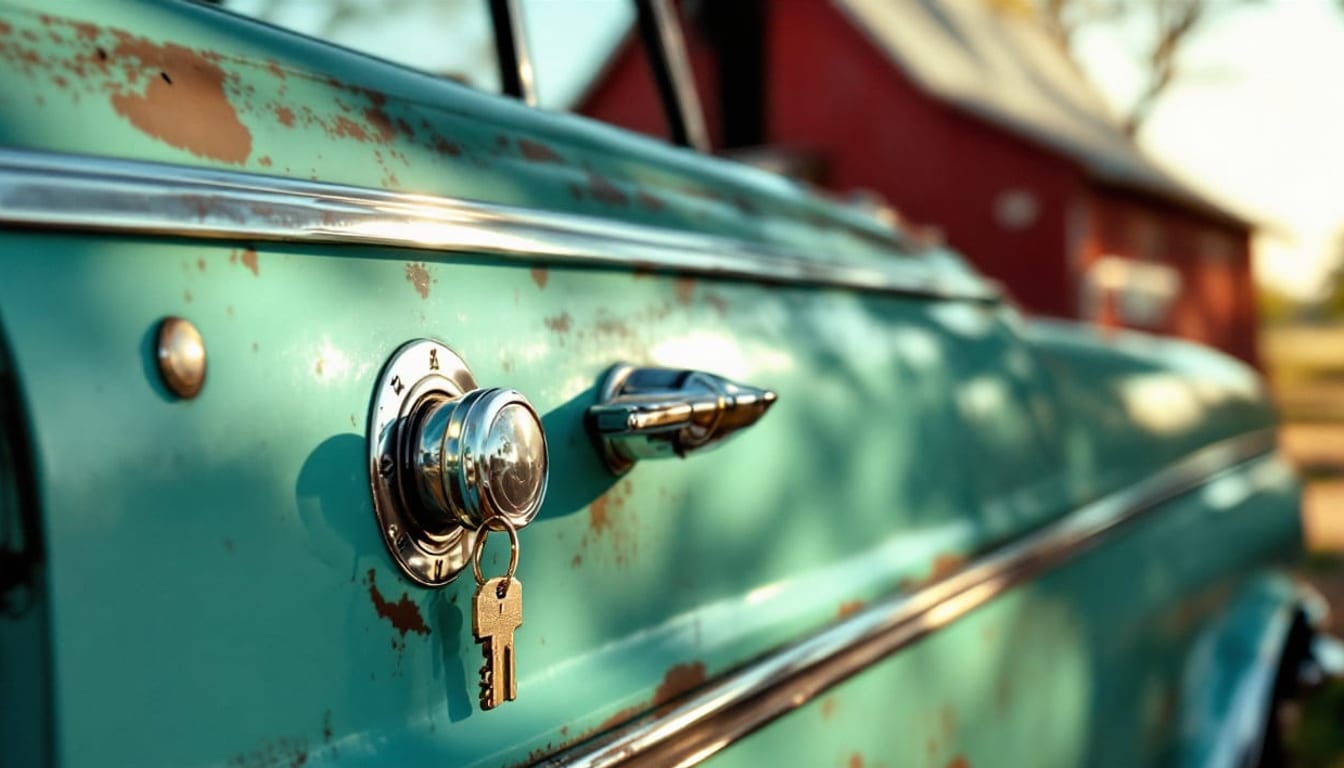
It is one of the most common calls we get about an older vehicle, and it usually starts the same way: the key slides into the driver's door, stops dead, and will not turn. Sometimes the passenger door works and the driver's does not. Sometimes the key turns all the way round and the door stays locked anyway. If you are standing next to the car right now, call or text (817) 214-2934 before you put any more force on that key.
Quick Answer
As of September 2026 in Granbury, a classic car or older truck whose door key will not turn is usually one of five things: the wrong key (many older vehicles used separate door and ignition keys), debris or hardened grease in the cylinder, a worn key, worn wafers inside the lock, or, if the key turns but nothing happens, a disconnected or broken linkage rod inside the door. Getting you in without damage starts at $50–$75. Rekeying or rebuilding a door cylinder falls in our $50–$150 per lock band, cutting a fresh key to a working lock is $75–$125, and originating a key with nothing that works is $100–$300. Mobile service inside our 25-mile radius is included.
Before Anything Else: Stop Turning Harder
The failure that turns a cheap call into an expensive one is a key that snaps off in the door.
Old door keys are brass, and many of them have been cut from a worn copy of a worn copy. The metal is thinner than it looks, and a door cylinder that is binding can take a lot of force before it gives, usually at the shoulder of the key where it enters the lock. A broken key in a door cylinder is still a job we can do, and extraction falls at the low end of our $75–$350 band, but it is always more work than the original problem.
So: stop, take the key out, and read the rest of this before trying again.
Work Through It in This Order
1. Make sure it is actually the door key
This is the most common answer by a wide margin on anything built before the late 1990s.
For decades many manufacturers issued two different keys with a new car. General Motors issued one key for the ignition and doors and a second for the trunk and glovebox. Ford, through much of the same era, did it the other way round in practice, with one key for the ignition and a different key for the doors and trunk, cut on a different keyway. Our 1980–1996 Ford F-150 and Bronco guide walks through the Ford system in detail.
Add fifty years of swapped cylinders and it is extremely common for an owner to be holding the ignition key and trying it in a door. If you have two keys, try the other one. If they look alike, check the heads and the blade profile side by side.
2. Try the other door and the trunk
If the passenger door opens with the same key, you have learned that the key is right and the driver's lock is the problem. Driver's door cylinders wear much faster than passenger cylinders, simply because they are used every single time.
If no door opens and the trunk does, you probably have the trunk key, not the door key. See step 1.
3. Look at the keyway
Shine a light into the lock. Door locks are exposed to everything: dust off a caliche road, pollen, wasp nests in cars that sit, and, most commonly, decades of lubricant that has turned into a gummy paste that holds the wafers down.
If you can see debris, gentle compressed air is fine. What is not fine is anything that adds more oil. See the section on what not to spray, below.
4. Look at the key
Hold your key next to a light and look at the cuts. If the peaks are rounded off, if the key is visibly bent, or if it is a copy you had made at a hardware store years ago, the key itself may be the problem rather than the lock. Worn keys stop lifting the wafers to the right height, and the lock refuses them.
A key that works in the ignition but not the door can still be a worn key, because the door is usually the lock that fails first.
5. The key turns, but the door stays locked
This is a different problem entirely, and it is good news for the lock.
If the key rotates smoothly and fully, but the button does not move and the door stays locked, the cylinder is working. What has failed is the connection between the cylinder and the latch inside the door: a small linkage rod and the plastic or metal clip that holds it to the cylinder's tailpiece. On a car this age, those clips go brittle and snap, or the rod simply pops out.
That is a door-panel job rather than a key job. A new key will not fix it, and we will not sell you one for it.
What Each Cause Costs in Granbury
| What is wrong | Typical Granbury range (September 2026) | Notes |
|---|---|---|
| Getting you into the vehicle without damage | From $50–$75 | See car lockout service |
| New key cut to a working lock (worn key was the problem) | $75–$125 | Cut to the lock, not copied from the worn key |
| Door cylinder cleaned, rebuilt or rekeyed | $50–$150 per lock | Same automotive rekey band we publish |
| Door cylinder replaced when worn past rebuilding | Quoted per vehicle | Depends on whether the cylinder and bezel are available |
| Key originated with nothing working | $100–$300 | Decode a cylinder, cut, test |
| Broken key extracted from a door lock | Low end of our $75–$350 range | Quoted after we see the break |
| Linkage rod or clip reconnected inside the door | Quoted at the vehicle | Door panel work, not key work |
| Mobile service anywhere inside our 25-mile radius | Included in the quote | No separate trip or call-out fee |
Those bands are the same ones published on our lock rekey service page and in our classic car one-key rekey cost guide, which covers bringing a vintage car's doors, trunk and ignition onto a single key once you are back in.
What Not to Spray in the Lock
Most people reach for whatever is on the garage shelf. On a vintage lock, that is often the wrong thing.
Avoid heavy oil and general-purpose penetrating spray as a long-term fix. It will often free a sticky lock for a day, which is why it is popular. Then it attracts dust, and on a car that sits between drives it becomes the gummy paste that caused the problem in the first place. Many door locks we open on cars from the 1960s through the 1980s are packed with exactly this.
A small amount of dry lubricant is the usual recommendation for a lock that is fundamentally healthy: a dry PTFE lock lubricant, or powdered graphite used sparingly. The operative word is sparingly.
Nothing replaces cleaning. A lock with decades of hardened grease in it needs to be taken out and cleaned, not given another layer. That is part of the rebuild we do inside the rekey band.
Why Classic Door Locks Wear the Way They Do
Most door locks on American cars from this era use wafer tumblers: thin flat plates that the key lifts into line so the plug can turn. They are simple, and there is real room for adjustment when we rebuild one, which is why a worn cylinder can often be saved rather than replaced.
They are also thin, and they wear. Every entry drags the key across the wafers. After fifty years of that, particularly on a driver's door, the wafers wear enough that a key no longer lifts them precisely. Early on, the lock becomes fussy: you have to pull the key back slightly, or jiggle it. Later, it stops accepting the key at all.
The fussy stage is the time to call. A cylinder that is merely fussy can be rebuilt. A cylinder that has been forced for another year often has a broken wafer, a bent key stuck in it, or both.
Why Cars That Sit Get This Worse
A classic that is driven every week rarely develops a door lock that seizes outright. A classic that sits in a barn or a storage unit for a season, then comes out for a car show, is where this call usually comes from.
Three things happen to a lock on a car that sits:
The lubricant hardens. Whatever was sprayed into the lock years ago keeps drying out. On a car in use, each turn of the key keeps the wafers moving through it. On a car that sits, the wafers stay in one position while the paste sets around them.
Dust and insects get in. A keyway is an open hole on the outside of a door. Mud daubers and wasps in particular like small dark openings, and a car parked under a Hood County shed roof for a summer can have a nest in a door lock by fall.
Humidity does its work. A lake-area barn is not a climate-controlled garage. Brass does not rust, but steel springs and retainers inside the cylinder can corrode, and a spring that has lost its tension lets a wafer hang.
The practical habit that prevents most of this is simple: when a car is going to sit, turn the key in each door lock every few weeks. It costs nothing and keeps the wafers moving. And when you bring a car out of storage, try the key gently in each lock before you need it to work, not at the moment you are trying to leave for the show.
If a lock has been sitting for years and now barely moves, bring it to us before forcing it. A cylinder that is gummed up but intact is usually a rebuild inside the rekey band. A cylinder with a key snapped off in it after a hard twist is a bigger job.
Getting In When Every Door Refuses
If no door will open and the key is inside or will not turn anywhere, the job becomes a lockout first and a lock repair second.
On a classic vehicle, opening it without damage matters more than on almost anything else, because the weatherstripping, window felts and door trim are often irreplaceable or very expensive to reproduce. Our guide to being locked out of a classic car with no spare explains how we approach that, and why we prefer to leave you with a working key rather than just an open door.
Two things to avoid while you wait: forcing a slim jim or coat hanger down the window channel of a car you do not know the inside of, and prying at a vent window. Both routinely damage linkages and glass on older cars.
If the Ignition Is Also Giving Trouble
A driver's door lock and an ignition that both started getting difficult around the same time are usually two separate worn cylinders on the same old car rather than one problem. The ignition side has its own diagnostic order, covered in our guide for when a truck key won't turn in the ignition. If both need work, doing them on the same visit costs less than two separate calls, and it is the natural moment to bring them onto the same key.
What We Need When You Call
Text these to (817) 214-2934:
- Year, make and model, and whether the door locks are original.
- Every key you have, side by side, heads visible.
- Exactly what happens: the key will not go in, goes in but will not turn, or turns but the door stays locked.
- Which locks do work: the other door, the trunk, the ignition.
- Where the vehicle is. We come to driveways, barns, storage units, car shows and parking lots anywhere inside our radius, including Acton, DeCordova, Pecan Plantation, Tolar, Lipan and Glen Rose.
- Proof of ownership: the title or registration in your name. We check it on every job.
Frequently Asked Questions
Why won't my key turn in my old car's door lock? The most common reasons are the wrong key (many older vehicles used separate door and ignition keys), hardened grease or debris in the cylinder, a worn key, or worn wafers inside the lock. If the key turns but the door stays locked, the linkage inside the door has failed instead.
How much does it cost to fix a classic car door lock in Granbury? Rebuilding or rekeying a door cylinder falls in our $50–$150 per lock band as of September 2026. A new key cut to a working lock is $75–$125, and getting you in without damage starts at $50–$75. A cylinder worn past rebuilding is quoted per vehicle.
Should I spray WD-40 in a sticky car door lock? Not as a long-term fix. Oily sprays can free a lock temporarily but attract dust and harden into the paste that causes sticking. A small amount of dry lubricant is better for a healthy lock, and a gummed-up lock needs cleaning rather than another layer.
The key turns all the way but the door won't unlock. What is that? The lock cylinder is working. The linkage rod or its clip inside the door has come loose or broken. That is door panel work, and a new key will not fix it.
Can you rebuild the original lock instead of replacing it? Usually yes. Classic wafer locks give real room for adjustment, and rebuilding keeps original hardware on the car. The exception is a cylinder with broken or badly worn wafers that no longer hold position.
My passenger door works but the driver's door doesn't. Why? The driver's door lock is used far more often and wears out first. If the same key opens the passenger door, the key is right and the driver's cylinder needs cleaning or rebuilding.
Can you get into a classic car without damaging it? Yes. We open older vehicles without prying at vent windows or forcing tools down the glass channel, because the weatherstripping and trim on many classics is irreplaceable. Where possible we leave you with a working key, not just an open door.
Do you need proof that I own the car? Yes, on every job. A title or registration in your name, or other documentation tying you to the vehicle.
Get It Fixed While It Is Still Only Fussy
A door lock that needs a jiggle is a cheap rebuild. A door lock that has been forced for another year is often a broken key and a replacement cylinder. Call or text (817) 214-2934, weekdays 8:00 AM to 7:00 PM, Saturdays 8:00 AM to 5:00 PM, with 24/7 emergency lockout availability. You can also request service through our contact page, or find a locksmith in Granbury who comes to you.
Sources
- Texas Department of Public Safety — Private Security Program
- Federal Trade Commission — how to find a locksmith you can trust
- National Highway Traffic Safety Administration — Federal Motor Vehicle Safety Standards
- National Insurance Crime Bureau
- Associated Locksmiths of America
- Texas Department of Motor Vehicles — titles and registration