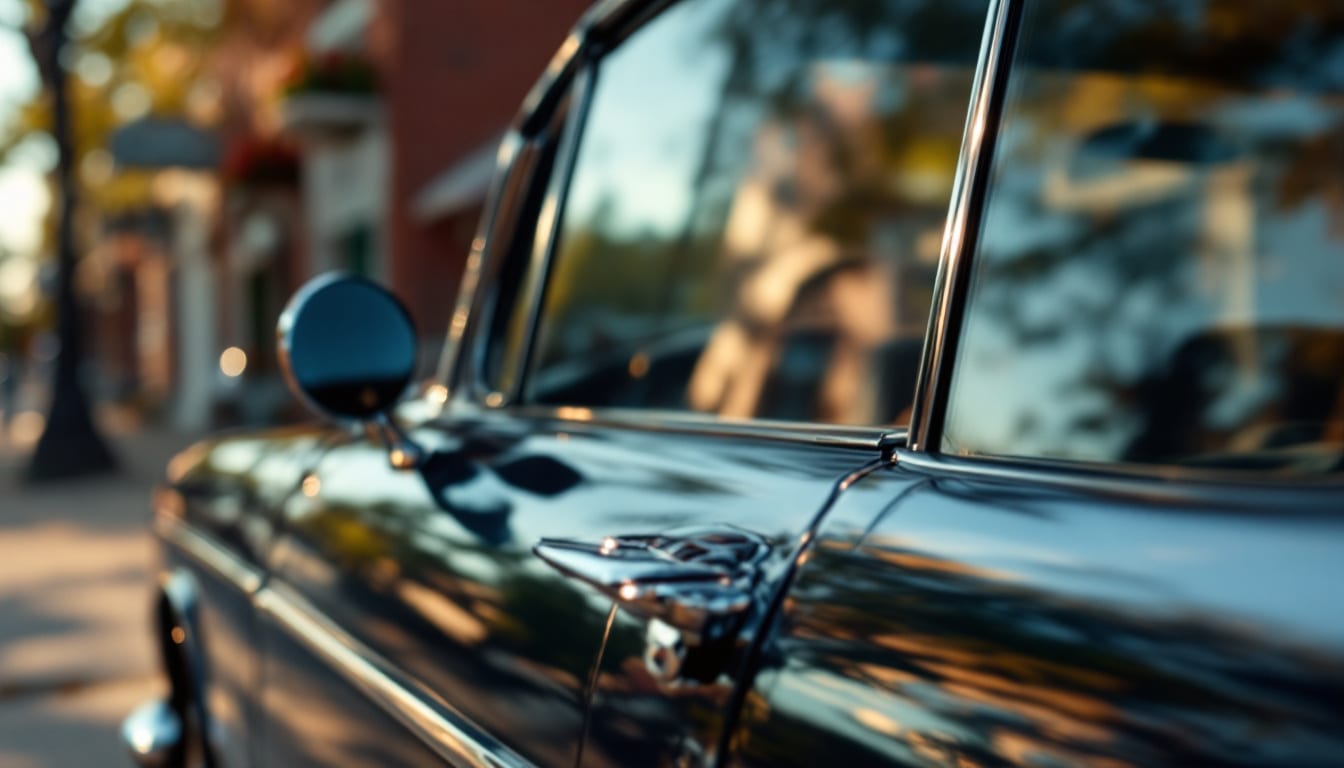
A modern lockout is an inconvenience. A classic car lockout is a decision about what you are willing to risk, because the trim around that window has not been manufactured since the Johnson administration. Call or text (817) 214-2934 before anyone puts a wedge in the top of that door.
Quick Answer
As of September 2026 in Granbury, getting a classic car open starts at $50–$75 for a standard unlock, and the right answer on a vintage vehicle is usually not to open the door at all — it is to pick or decode the lock and cut you a key on the spot, at $100–$300, so you drive away with a working key instead of an open door and the same problem tomorrow. The one thing worth insisting on: no wedging, no prying and no drilling on a car whose chrome, stainless reveals and curved glass are either unobtainable or cost more than the entire job. If a child or pet is inside and the weather is hot, call 911 first and us second.
Before Anything Else: the Heat
Hood County summers are not the place for patience if somebody is inside the car.
A closed vehicle in direct Texas sun heats far faster than people expect, cracking a window barely changes it, and children and dogs are affected long before an adult would be. The National Highway Traffic Safety Administration publishes hot-car guidance for exactly this reason. If there is a child or an animal in that car and it is warm out, call 911 immediately. Emergency services are closer, faster and authorised to break glass. Call us as well, and if we are nearer we will run, but nobody should be waiting on a locksmith in that situation.
Everything below is about an empty car.
Why a Classic Lockout Is a Different Job
Almost everything a modern lockout relies on is missing on a vintage vehicle.
No keyless entry, no remote, no app. There is no second electronic route in. The lock is the only way in, which is actually good news — it means the job is lock work rather than electronics.
No forgiving trim. A modern door has a flexible weatherstrip, a plastic window frame and a shell designed with some tolerance. A 1960s or 1970s American car has stainless window reveals, chrome trim, painted metal frames and rubber that has been baking in Texas sun for fifty years. Rubber that old does not flex, it splits. Stainless that old does not spring back, it kinks — and a kinked reveal is visible from across a car park forever.
Glass you may not be able to buy. People reach for "just break the cheapest window" as the emergency answer. On a lot of classics there is no cheap window. Curved rear glass, wraparound windshields and date-coded original glass range from expensive to genuinely unobtainable, and on a judged car the date stamp is part of what is being judged.
Exposed linkage. Inside a classic door, the rods that operate the latch and lock are simple and reachable — easier to work than a modern door, and much easier to bend or dislodge. A rod knocked off its clip turns a lockout into an interior door-panel job.
But: often a legitimate easy route. Many cars up to the late 1960s have vent or wing windows with a simple mechanical latch. On the right car, rotating that latch with the correct tool is a clean, damage-free entry that a modern car simply does not offer. Knowing which cars have that route, and which have a latch that will snap rather than turn, is the difference between a five-minute job and a repair bill.
The Two Things That Can Go Wrong, and Who Causes Them
Both of the classic-car damage stories we get called about afterwards come from the same source: somebody treating a vintage car like a 2021 Camry.
The wedge at the top of the door. The standard modern technique is to wedge the top of the door frame open and work a tool down inside. On a car with a stainless reveal and hardened rubber, that is how trim gets creased and weatherstrip gets torn. The damage is usually not dramatic — a slight ripple, a split at a corner — and it is usually permanent.
The drill. Drilling a lock is a legitimate last resort on a modern car where the cylinder is a cheap replaceable part. On a classic, drilling destroys an original date-correct cylinder that may be difficult to replace, and frequently damages the bezel around it, which is more often the unobtainable part than the lock itself. Nobody should drill a classic car lock without a specific conversation with the owner first, and that conversation should include what the replacement part actually costs and whether it exists.
If you are calling a national dispatch line rather than someone local, say the words "this is a classic car, do not wedge it and do not drill it" before anyone is sent. Whoever arrives may be excellent. They may also be whoever was nearest.
The Better Outcome: Leave With a Key
This is the part most people do not know to ask for, and it is the reason to call a locksmith rather than a general roadside service.
If your classic's lock cylinders still function, a locksmith can pick the lock to get in, then decode that cylinder and cut you a working key on the spot. You are not paying to open a door. You are paying to end the problem. Cars of this era use wafer tumbler locks — flat brass plates rather than the round pins in a house lock — which are well within reach of a competent hand and, critically, can be read for their cutting depths once open.
Think about the alternative. An unlock alone gets you home today, with exactly as many keys as you had this morning, which is zero. The next time the door shuts on its own you are making this call again. A key originated during the same visit sits in the $100–$300 band and closes the whole thing out.
And while we are there, ask about the rest of the car's locks. Most classics have four or five cylinders and half the owners we meet do not know which key does what. Bringing the ignition, doors, trunk and glovebox onto one key is a job we quote per vehicle, and it is cheapest as part of a visit you are already paying for.
What This Costs in Granbury
| Job | Typical Granbury range (September 2026) | Notes |
|---|---|---|
| Classic car unlocked, keys visible inside | From $50–$75 | Non-destructive entry, no wedging |
| Unlock plus a key originated during the same visit | $100–$300 | The recommended outcome — you leave with a key |
| Duplicate cut to a cylinder that already works | $75–$125 | Do this the same day for a spare |
| Broken key extracted from a door or ignition | Low end of our $75–$350 range | Quoted once we see the break |
| Ignition cylinder repair or replacement | $150–$350 | Includes a key cut to the new cylinder |
| Ignition, doors, trunk and glovebox onto one key | Quoted per vehicle | Cheapest bundled into a visit already booked |
| Mobile service inside our 25-mile radius | Included in the quote | No separate trip or call-out fee |
Those bands are the same ones published across this site, including on our car lockout service page and our classic car key replacement cost guide. The quote you get on the phone is the quote you pay — travel inside the radius is in the number, not added at the end.
What Not to Do While You Wait
Do not use a coat hanger or a screwdriver. This is the advice the internet gives and it is the advice that produces the repair bills. On a classic you are reaching past painted metal and old rubber toward linkage rods that are easy to knock out of position.
Do not force the vent window. If your car has one, it may well be the clean way in — but the latch and the pivot posts on a fifty-year-old vent are brittle, and forcing one usually means sourcing a replacement assembly.
Do not spray anything into the lock yet. Penetrating oil in a wafer cylinder attracts grit and makes the lock harder to read afterwards. If the lock has been sticking, tell us — that is useful information, not a problem to pre-treat.
Do check the other doors and the trunk, gently. On cars of this era it is genuinely common for one door to be unlocked, or for a trunk lock to be worn enough to turn with a key that no longer works the doors. It costs nothing to try.
Do look for the spare you may already have. In a house with a classic car there is very often a key in a desk drawer, a toolbox, a workshop pegboard, or the envelope that came with the car. Ten minutes of looking beats any service call.
Why Wafer Locks Do Not Protect a Classic Anyway
Worth saying, because the lockout conversation usually leads straight into it.
A vintage vehicle generally has no immobilizer of any kind. The engine does not check who turned the key. Federal theft-protection requirements under FMVSS 114 built up over time, and the electronic immobilizers that make a modern car genuinely difficult to drive away arrived on mass-market vehicles long after the cars we are talking about were built.
So if today's lockout has you thinking about security, the effective measures on a classic are the physical and administrative ones: a hidden battery disconnect or ignition cut-off, a visible steering or wheel lock, storage that is covered and not overlooked by the road, an agreed-value insurance policy rather than a standard one, and photographs plus the VIN and engine numbers filed somewhere other than the glovebox. The National Insurance Crime Bureau publishes owner resources on exactly that documentation, and it is the part almost every collector means to do and has not.
Proof of Ownership, Every Time
We ask everybody, and we ask before we start rather than after.
A classic car is worth as much as a house deposit and the person locked out of it is occasionally not the person who owns it. Locksmiths working in Texas are regulated through the Texas Department of Public Safety Private Security Program, and verifying ownership is part of doing the job properly rather than an inconvenience we invented.
A title, a registration, an insurance card, a bill of sale or dealer paperwork all work, and on a car whose paperwork lives in the locked glovebox we will work with you on it — a driving licence matching an insurance record, or a household member who can produce the documents, is normally enough to get started.
What We Need When You Call
Tell us these five things and we will arrive with the right tools rather than the general ones:
- Year, make and model, and whether the car is original or restored.
- Which doors and windows exist: does it have a vent or wing window, and are the windows up or down?
- Where the keys are — visible inside, definitively lost, or simply unknown.
- Whether any lock on the car still turns with any key you own.
- Where the car is and how long it can safely stay there. A shoulder on a county road is a different urgency from a garage.
Photographs of the door lock face and the window trim help more than a description. Text them to (817) 214-2934.
Frequently Asked Questions
How much is an auto lockout in Granbury? Standard unlocks start at $50–$75, and mobile travel anywhere inside our 25-mile radius is included in that quote rather than added afterwards. On a classic car the better value is usually the unlock plus a key originated during the same visit, in the $100–$300 band, because you leave with a working key instead of the same problem.
Can you open a classic car without damaging the trim? Yes, and on a vintage vehicle that is the entire job. The technique is non-destructive entry through the lock itself, or through a vent window latch on cars that have one — not wedging the top of the door, which is what creases stainless reveals and splits fifty-year-old weatherstrip. Say "classic car, no wedging, no drilling" to whoever you call.
Can you make a key for my classic while you are there? Usually yes, and it is what we recommend. If the cylinders still function we pick the lock, read the cylinder for its cutting depths, and cut a key on site. That runs $100–$300 and ends the problem rather than postponing it. Cut a second copy the same day at $75–$125 while the van is still there.
Should I just break a window? Almost never on a classic. Curved rear glass, wraparound windshields and date-coded original glass are expensive at best and unobtainable at worst, and on a judged car the date stamp is part of the car's value. The only exception is a person or an animal inside in the heat, and in that case call 911 rather than deciding yourself.
Will you drill my lock? Not without a specific conversation first. Drilling destroys an original date-correct cylinder and often damages the bezel around it, which is frequently harder to replace than the lock. On a classic it is a last resort, discussed with the owner, with the replacement part identified before anyone starts.
Do you come out to me, or do I need a tow? We come to you, anywhere inside 25 miles of Granbury — Acton, DeCordova, Pecan Plantation, Tolar, Lipan, Cresson, Nemo, Bluff Dale, Glen Rose and out to the county lines. A classic that cannot be started does not need a trailer to get a key made; mobile service exists precisely for that.
What proof of ownership do you need? A title, registration, insurance card, bill of sale or dealer paperwork. We ask everyone, before starting rather than after. If the paperwork is inside the locked car, a driving licence that matches an insurance record, or a household member who can produce documents, normally gets us moving.
How long does a classic car lockout take? The entry itself is usually well under half an hour on a car with functioning locks. Originating a key adds time, because the cylinder has to be read and the key cut and then tested in every lock you want it to operate. Plan on an hour or a little more for the full job rather than the bare unlock.
Get It Open Without Getting It Damaged
Tell us the year, make and model and what still turns, and you will get a plan and a number before anyone touches the car. Call or text (817) 214-2934, weekdays 8:00 AM to 7:00 PM, Saturdays 8:00 AM to 5:00 PM, with 24/7 emergency availability. You can also request service through our contact page, read what a classic car key actually costs, see the 1988–1998 Chevy C/K and Suburban key guide, or the 1980–1996 Ford F-150 and Bronco version if that is what is sitting in your driveway.
Sources
- National Highway Traffic Safety Administration — heatstroke and vehicle safety
- National Highway Traffic Safety Administration — Federal Motor Vehicle Safety Standards
- Texas Department of Public Safety — Private Security Program
- National Insurance Crime Bureau — vehicle theft prevention resources
- Texas Department of Motor Vehicles — titles and registration
- Associated Locksmiths of America