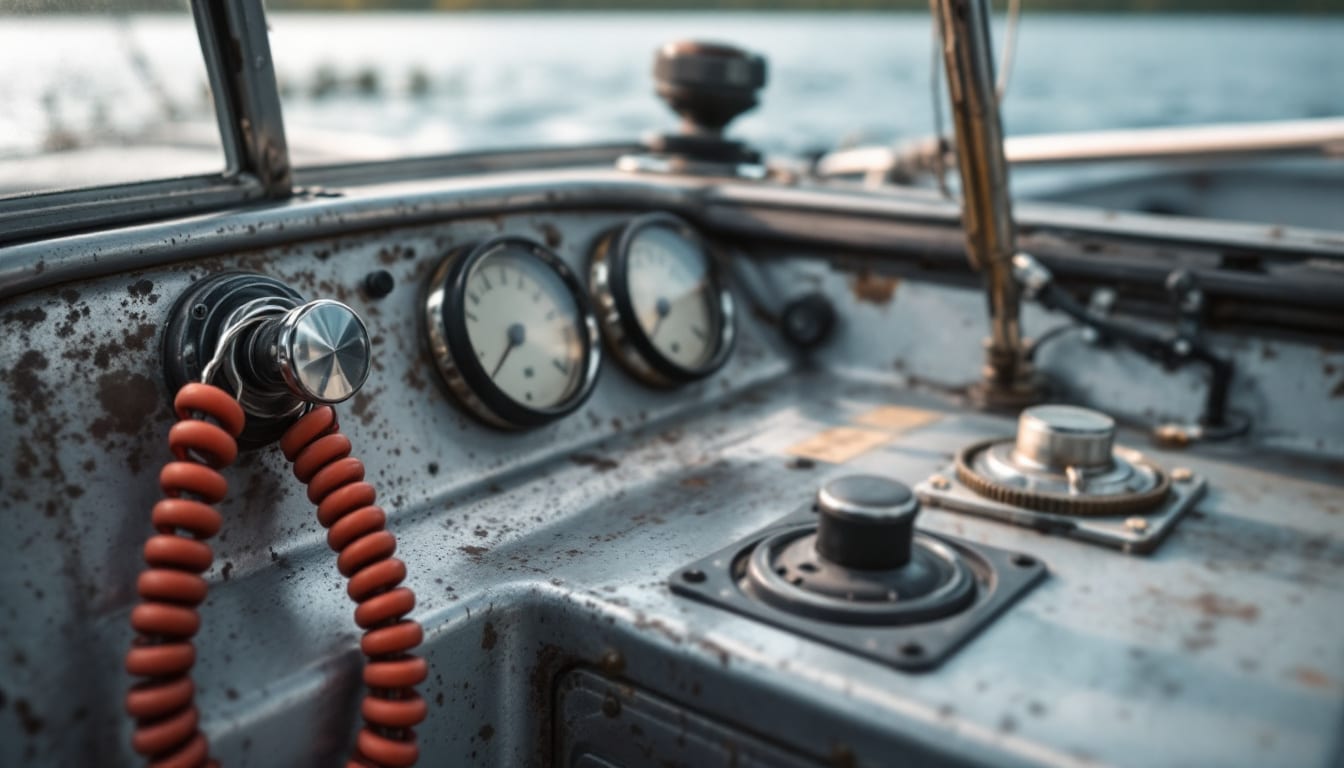
The engine is off, the boat is tied up, and the key will not come out of the switch. Or it comes out, but only when the switch is in a position that leaves the gauges on and the battery draining. Either way you cannot leave the boat at the dock with a key hanging out of the dash. If that is where you are standing right now, call or text (817) 214-2934, and do not reach for the pliers yet.
Quick Answer
As of September 2026 around Lake Granbury, a boat key that will not come out of the ignition is usually one of five things: the switch is not fully in the OFF position, corrosion or grit inside the switch, a worn or bent key, a key that was cut sloppily and no longer matches the switch cleanly, or a failed switch whose internal detent has broken. Extracting a stuck or broken key lands at the low end of our $75–$350 range, a fresh key to a working switch is $75–$125, and an ignition switch or cylinder replaced with keys fitted is $150–$350. Mobile service at the ramp, dock or lake house inside our 25-mile radius is included.
Why Boat Ignitions Hold Onto the Key
Most boat ignition switches, like most car ignitions, are designed to release the key in only one position, OFF. That is deliberate: it stops a key being pulled out while the engine is running and the dash is live.
So a key that will not come out is very often a switch that thinks it is not in OFF, even when the engine is silent. The engine might have been stopped by the kill-switch lanyard, by a stall, or by shutting off fuel, while the ignition itself was left in RUN or ACC. The key is behaving exactly as designed.
The rest of the time, something inside the switch is worn, dirty, corroded, or broken, and that is where a locksmith comes in.
Work Through It at the Dock, in This Order
1. Turn the key fully to OFF, then a touch past
Rotate the key firmly back to the OFF position. Many marine switches have a distinct click at OFF and a little spring-loaded resistance just before it. A key parked a few degrees short of that click will not release.
If the engine was killed with the lanyard, the key is almost certainly still in RUN. Turn it back to OFF, then try pulling it straight out, without twisting.
2. Check the lanyard and any key-switch cover
On some dashes the safety lanyard clip sits right next to the ignition, and a lanyard cap or a rubber weather cover can press against the key head enough to hold it at an angle. Unclip the lanyard, fold back any cover, and try again with a straight pull.
3. Gently rock, do not force
With the key at OFF, apply very light pressure back toward ACC and toward OFF while pulling gently straight out. A worn wafer that is sitting slightly high will sometimes drop back when the key is rocked a degree or two.
The operative word is gently. Boat keys are brass, often copies of copies, and they break at the shoulder where they enter the switch.
4. Look at the key
If you can see the key blade, look for a visible bend, especially where a heavy floating keychain has been swinging from it for a season. A key bent even slightly will bind in the switch. Take a look at the spare, too: if the spare comes out cleanly and the everyday key does not, the everyday key is your answer.
5. Think about the weather
A boat switch sits in an open dash. It gets rain, spray, sun, and lake humidity, and it sits for weeks between trips. Oxidation and grit inside the switch are among the most common reasons a key starts sticking, often getting gradually worse over a season rather than failing suddenly.
What Not to Do
Do not use pliers on the key head. It feels like the obvious answer. It is the fastest way to snap the key off flush with the switch face, and a snapped key is always more work than a stuck one.
Do not spray heavy oil into the switch and walk away. It may free the key for the afternoon, and then it collects dust and grit and gums the switch worse. A switch sticking from corrosion needs to be cleaned or replaced, not coated.
Do not leave the switch in RUN or ACC overnight just because the key is stuck there. On many boats that leaves gauges, a fish finder, or a bilge circuit drawing current. If you have a battery disconnect switch, turn it off until the key is dealt with.
Do not leave the key in an unattended boat. A boat with a key in the dash is a boat anybody can start. If you have to leave, disconnect the battery, and take the boat out of the water if you can.
What Each Cause Costs Around Lake Granbury
| What is wrong | Typical Granbury range (September 2026) | Notes |
|---|---|---|
| Stuck key released, switch still healthy | Low end of our $75–$350 range | Quoted after we see it |
| Broken key extracted from the switch | Low end of our $75–$350 range | Depends on how deep it broke |
| New key cut to a working switch | $75–$125 | Cut to the switch, not copied from a worn key |
| Key originated with nothing working | $100–$300 | Decode the switch, cut, test |
| Ignition switch or cylinder replaced, keys fitted | $150–$350 | Includes testing every position |
| Trailer or tongue box lock opened or rekeyed | $50–$150 per lock | Often done on the same visit |
| Tow vehicle unlocked at the ramp | From $50–$75 | See car lockout service |
| Mobile service anywhere inside our 25-mile radius | Included in the quote | No separate trip or call-out fee |
Those bands are the same ones on our ignition repair service page and in our boat, ATV and RV key cost guide.
Repair or Replace the Switch?
On a car, a worn ignition cylinder is usually replaced on its own and the key cut to match. Boats are more varied.
Some marine ignitions have a serviceable key cylinder in a separate switch body, much like a car. On those, the cylinder can often be cleaned or replaced and keyed without disturbing the wiring behind the dash.
Many marine ignitions are a single sealed unit: key cylinder and electrical switch built together. When the lock part of those fails, the whole switch is replaced, and it usually arrives with its own new keys. The wiring on the back is moved across terminal for terminal and every position is tested before we leave.
Some are built into the engine's remote control box rather than the dash. Those are a more involved replacement because of how the box comes apart, and we will tell you on the phone if that is what you have.
Either way, we test the key at every position with the engine, not just on the bench: OFF releases the key, ACC powers accessories, RUN holds, START cranks and springs back.
Where the Line Is Between Us and a Marine Mechanic
We would rather say this up front than after a trip.
This is our job: a key that will not come out, will not turn, or is broken off; a lost key; a worn switch or cylinder; keys matched across the boat, trailer and tow vehicle.
This is a marine mechanic's job: the engine will not crank or run once the key is fine, the starter clicks, the battery will not hold a charge, or the wiring behind the dash has been damaged.
If the key turns fine but the engine will not start, that is a separate problem with its own checklist in our guide to a boat key that turns but the engine won't crank.
The Heavy Keychain Problem
One cause is worth singling out, because it is completely preventable and we see it constantly on lake boats.
A large floating keychain is a good idea: it keeps the key from sinking if it goes over the side. But hanging from the key while the boat bounces across a choppy lake, it acts as a lever on the switch for hours at a time. Over a season or two that wears the switch and bends the key, and eventually the key starts binding.
The fix costs nothing. Keep the float, but take it off the key ring that goes in the switch while underway, or use a short, light float. The same advice applies to cars, where a heavy keychain is one of the main reasons ignition cylinders wear out, which we cover in our guide for when a truck key won't turn in the ignition.
End-of-Season Habits That Keep the Switch Working
Most stuck-key calls we run at the lake could have been a five-minute habit at the end of the previous season. None of these need a locksmith.
Work the key through every position before storage. OFF, ACC, RUN, OFF, a few times, then remove it. A switch that sits for months in one position is more likely to stick when spring comes around, the same way a door lock on a car that sits does.
Keep the switch covered. Many dashes have a rubber or vinyl weather cap over the ignition. If yours is missing or cracked, replacing it keeps rain and dust out of the keyway between trips. A boat cover that sheds water off the console does the same job.
Store the key off the boat. Not in the console, not in the dry box, not taped under the seat. Aside from the theft risk, a key stored in a hot, damp console corrodes faster than one kept indoors.
Keep a spare, and use it occasionally. A spare that has never been tried is not a spare. Start the boat with it once a season. If the spare comes out of the switch cleanly and the everyday key does not, you have learned the everyday key is worn before it strands you.
Rinse after any brackish or treated water. Lake Granbury is fresh water, but boats that travel to the coast or sit in treated marina water pick up salts that are hard on switch internals. A fresh-water rinse of the dash area, with the switch covered, helps.
Watch for early warning signs. A key that needs a wiggle to come out, or feels gritty going in, is a switch asking for attention. Fixing it at that stage is cheaper than extracting a broken key mid-season.
If the Key Went in the Lake Instead
If the problem is not a stuck key but a missing one, the process is different: a key can be made for most boat switches by decoding the switch and cutting to it, without the original. Our guide to a lost boat key at the ramp walks through what to have ready. Keep the lanyard attached to the operator while underway, as the Texas Parks and Wildlife Department boating rules require on craft equipped with one, and a key that goes over the side is much less likely.
What to Send Us Before We Come Out
Text these to (817) 214-2934:
- Make and year of the boat and the engine, and whether the ignition is on the dash or on the remote control box.
- A photo of the switch face with the key in it.
- Which position the key is stuck in, and whether the engine was stopped by the key, the lanyard, or a stall.
- Whether the key is intact or has broken off.
- Whether you have a spare, and whether the spare behaves differently.
- Where the boat is: ramp, marina slip, lake house dock, or on the trailer at home.
- Proof of ownership: registration or title matched to the hull identification number.
We come to Lake Granbury ramps and marinas, lake houses in DeCordova and Pecan Plantation, and storage lots anywhere inside our radius.
Frequently Asked Questions
Why won't my boat key come out of the ignition? Most often the switch is not fully in OFF, because many marine switches release the key only in that position. If the engine was stopped by the lanyard, the key is usually still in RUN. Other causes are corrosion or grit in the switch, a bent or worn key, a sloppily cut copy, or a broken switch detent.
How much does it cost to fix a stuck boat key in Granbury? Releasing a stuck key or extracting a broken one falls at the low end of our $75–$350 range as of September 2026. A new key cut to a working switch is $75–$125, and a replaced ignition switch or cylinder with keys fitted is $150–$350.
Can I use pliers to pull out a stuck boat key? It is the most common way a stuck key becomes a broken one. Brass keys snap at the shoulder where they enter the switch. Turn the key fully to OFF and pull straight out, gently, and stop if it does not come.
Is it safe to leave the boat with the key stuck in it? Not really. A key in the dash means anyone can start the boat, and a switch left in RUN or ACC can drain the battery. Turn off the battery disconnect if you have one, and get the key dealt with before leaving the boat unattended.
Do I need a locksmith or a marine mechanic? A key that will not come out, turn, or has broken is locksmith work, as is a worn switch or cylinder. If the key works fine but the engine will not crank, that is usually a marine mechanic.
Will you replace the whole ignition switch? When the lock is built into a sealed switch, yes. The new switch is wired terminal for terminal and tested in every position. Where the cylinder is serviceable on its own, it can often be replaced without touching the wiring.
Can a heavy floating keychain damage the ignition? Yes. Swinging from the key over a choppy lake, it levers on the switch for hours, wearing it and bending the key over a season or two. Keep a light float, or take the float off the ring that goes in the switch while underway.
Do you come to the boat ramp? Yes. Mobile service anywhere inside 25 miles of Granbury is included with no separate trip fee, including ramps, marinas, lake house docks and storage lots.
Get It Out Before It Breaks
A stuck key is a small job. A snapped key is a bigger one, and a key left in an unattended boat is a different kind of problem. Call or text (817) 214-2934, weekdays 8:00 AM to 7:00 PM, Saturdays 8:00 AM to 5:00 PM, with 24/7 emergency availability. You can also request service through our contact page, or find a Granbury locksmith who comes to the dock.
Sources
- Texas Parks and Wildlife Department — boater education
- U.S. Coast Guard Boating Safety — engine cut-off switch FAQ
- Brazos River Authority — Lake Granbury
- National Association of State Boating Law Administrators
- Texas Department of Public Safety — Private Security Program
- Associated Locksmiths of America