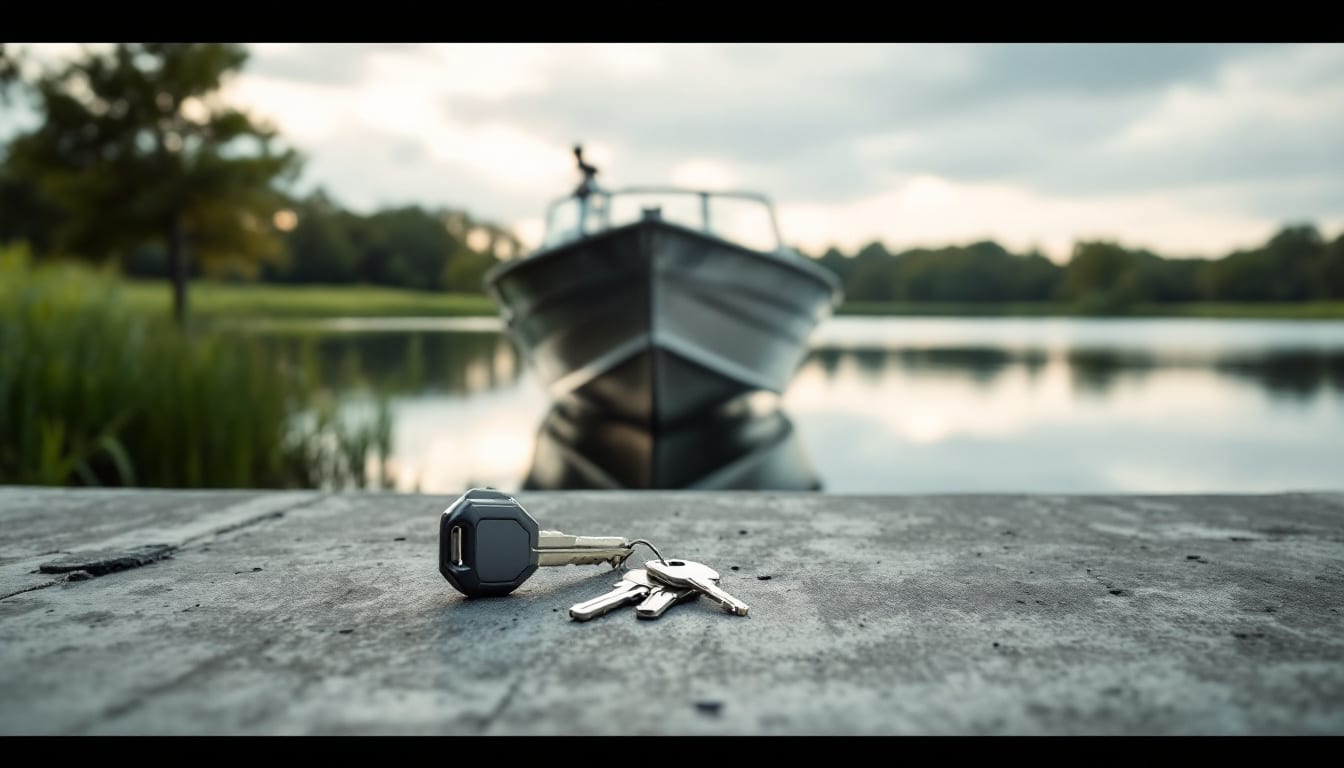
Around Lake Granbury a household keyring is rarely just car keys. There is a boat key, a trailer coupler lock, an ATV or side-by-side, a mower, a camper door, and two or three compartment locks nobody can identify. They all get lost the same way — in the water, in the pasture, in a coat pocket from last October. Call or text (817) 214-2934 and tell us what the equipment is.
Quick Answer
As of August 2026 in Granbury, most boat, ATV, mower, trailer, and RV keys are plain mechanical keys with no chip, and they land at the low end of our $75–$350 service range — commonly $75–$125 when a key can be duplicated or cut from a code stamped on the lock, and up to $100–$300 when a cylinder has to be removed and decoded because nothing works. Recreational-equipment keys are almost always cheaper than car keys. What raises the price is a lock that has to come apart, not the machine it belongs to.
What a Locksmith Actually Does on This Equipment — and What We Don't
Being clear about scope saves everyone a trip, so here is the honest line.
We do the lock and key side. Cutting keys from a code, duplicating a worn key, decoding a cylinder that has no key, extracting a broken key, and rekeying a lock so an old key stops working. That is the same craft whether the cylinder is bolted to a car door, a boat dash, a fifth-wheel compartment, or a trailer coupler.
We do not do marine or powersports engine work. If your boat's key turns and the engine will not crank, that can just as easily be a battery, a corroded ground, a lanyard kill switch, a shift interlock, or a starter solenoid. Those belong to a marine mechanic, and we will tell you so rather than sell you a key that was never the problem. We wrote a separate diagnosis walkthrough for exactly that situation: boat or ATV key turns but nothing happens.
We do not defeat locks on equipment you cannot show ownership for. More on that below, because on boats and trailers it comes up far more often than on cars.
Granbury Pricing
| Equipment or job | Typical Granbury range (August 2026) | Notes |
|---|---|---|
| Duplicate a working boat, ATV, mower, or RV key | $75–$125 | Most common request by far |
| Key cut from a code stamped on the lock or ignition | $75–$125 | Fastest no-key path when a code is visible |
| Key originated by decoding a cylinder, nothing working | $100–$300 | Cylinder may have to be removed |
| Broken key extracted from a lock or ignition | Low end of our $75–$350 range | Quoted after we see the break |
| Trailer coupler, toolbox, or compartment lock rekeyed | Quoted per lock | Cheaper as a batch than one at a time |
| RV coach door and baggage locks matched to one key | Quoted per rig | Depends how many cylinders you want matched |
| Tow vehicle key or fob, transponder or smart key | $80–$350 | Standard automotive pricing applies |
| Tow vehicle unlocked at a ramp or launch | From $50–$75 | See car lockout service |
There is rarely a dealer comparison to make here. A boat dealer or powersports dealer will typically order a cylinder assembly rather than make a key, which means waiting on a part and paying for hardware you did not need. For the automotive side of the same trip — the truck that pulled the trailer — dealer key work commonly starts at $200–$600, and our mobile pricing runs 40–60% below that. The dealer cost comparison covers that math in detail.
Boat Keys
Most outboard and sterndrive ignition switches use a small wafer key, and most manufacturers historically used a limited set of key patterns shared across thousands of boats. That has two consequences worth knowing.
Your key probably starts other boats at the ramp. This is normal and it is not a defect. It is also the reason a boat's ignition key is not a security device and should never be treated as one.
A code is often stamped somewhere. On many ignition switches the pattern is printed or stamped on the switch body, the back of the cylinder, or the original paperwork in the glovebox. If you can photograph that stamping, we can frequently cut a key from it without touching the boat — which is the cheapest possible version of this job.
If no key exists and no code is visible, the cylinder gets decoded. That is straightforward mechanical work, and it is why the no-key band runs higher than duplication.
One practical note about the lake: a key that has been in the water and then in the sun is often not worn out, it is corroded. Green crust in the cylinder makes a good key feel like a bad one. Before you conclude the key is wrong, look at the lock.
ATVs, UTVs, and Side-by-Sides
Same principle, smaller hardware. Most ATV, UTV, and side-by-side ignitions use a simple wafer cylinder and a shared key pattern, and duplication is quick and cheap.
Two exceptions to flag up front:
Some newer machines have a chip or a coded fob. Higher-trim side-by-sides and some recent models have moved toward coded keys, digital security, or push-button start. If yours does, that becomes a programming job rather than a cutting job, and the answer depends on the specific machine — we check before quoting rather than after arriving.
Aftermarket ignition switches are everywhere. A universal switch bought online and wired in after a theft or a failure means the original key pattern is gone. The key we make matches the switch that is currently on the machine, whatever it is.
Mowers, Tractors, and Equipment
Zero-turns, riding mowers, and compact tractors mostly use the same family of small wafer keys, frequently shared across an entire brand. Duplication is trivial. Origination without a key is a decode.
The one thing worth saying: on a lot of this equipment, the ignition switch costs less than the labor to decode it. If a cylinder is worn out on a mower, replacing the switch is sometimes the cheaper answer, and we will tell you that even though it is the smaller ticket.
Trailers, Couplers, and Toolboxes
This is where most people actually get stuck, because a trailer accumulates locks.
- A coupler lock or hitch pin lock
- A ramp door or cargo door lock
- One or more toolbox or truck-box locks
- Tie-down or spare-tire locks
They are usually all different keys, and they are usually all lost separately. The efficient move is to have them rekeyed to match one key in a single visit rather than paying for four separate small jobs across a year. When you call, count the cylinders before we quote.
Broken keys in coupler locks are extremely common — small blades, high torque, and weather. Extraction is usually possible; sometimes the lock is corroded past saving and replacing it is honest advice rather than an upsell.
RVs, Campers, and Fifth Wheels
An RV is really three lock systems in one vehicle:
The chassis. On a motorhome, the driving side is an automotive vehicle with an automotive key or fob, and it prices like one — $80–$350 depending on whether it is a plain key, a transponder, or a smart key. If it is a transponder, our transponder key guide explains that side, and the transponder vs smart key vs fob comparison helps you identify which one you have.
The coach door. Entry-door locks on travel trailers and motorhomes have historically used a small number of shared key patterns — the same "your key opens the neighbor's camper" situation as boats. Many owners upgrade this deliberately once they learn it, and rekeying the coach door to a unique key is a reasonable security decision.
The baggage and compartment locks. Usually a separate shared pattern again, often all identical to each other across the rig. These are the ones worth matching to a single key.
The most common RV call we get in Hood County is not a lost key. It is a stored rig whose owner cannot find any of the three sets after a winter, and wants one visit that produces a working key for everything.
When a Shared Key Pattern Becomes a Security Decision
Two facts from the sections above are worth putting together, because owners rarely do.
Marine ignition switches, RV coach doors, and RV baggage locks have all historically used small sets of shared key patterns. That is convenient for manufacturers and dealers, and it means the lock on your camper door is very likely opened by a key that thousands of other people already carry.
For a boat's ignition that is mostly harmless — the engine is not what a thief is walking off with, and the safety lanyard has to be present anyway.
For an RV or an enclosed trailer it is a different calculation, because the compartments hold generators, tools, fishing and hunting gear, and everything that did not fit in the truck. A rig parked in a storage lot from October to April is unattended for months in a place where a stranger with a common key is not out of place.
Rekeying those cylinders to a unique key is a modest job and it is the single most useful security upgrade available on this equipment. Done as a batch during one visit — coach door, baggage doors, and the trailer's coupler and toolbox locks — it is far cheaper than the same cylinders handled one at a time across two seasons, and you leave with one key instead of six. Our car lock rekey service covers the same work on the tow vehicle's door and trunk cylinders.
The one thing not to do is replace a shared-pattern lock with another shared-pattern lock bought off a shelf. That is the same exposure in a new housing.
Proof of Ownership Matters More Here, Not Less
On a car, ownership documentation is routine. On recreational equipment it is genuinely important, and we hold the line on it.
Boats, trailers, ATVs, and RVs are stolen, abandoned, bought at auction, and inherited far more often than passenger cars, and they sit unattended at ramps, storage lots, and pastures where nobody would question a stranger working on one. Texas locksmiths operate under the Texas Department of Public Safety Private Security Program, and originating a key for equipment we cannot tie to the person asking is exactly the kind of work that program exists to prevent.
What works: title, registration, a bill of sale, insurance in your name, or a storage-facility agreement — plus matching photo ID. For a trailer with no title, registration or a bill of sale plus ID is normally fine. For a boat, the TPWD registration card is the usual document.
What does not work: "it's my buddy's and he said it's fine." Have your buddy meet us there or send documentation. We would rather lose the call than open the wrong boat.
What to Have Ready When You Call
- What the equipment is — make, model, and roughly what year, including whether a side-by-side or newer machine has push-button start.
- Whether any key works anything on it, including a compartment or a door.
- A photo of the lock face and any stamped code or number, if one is visible. This single photo is the difference between cutting a key at the shop and decoding a cylinder in a pasture.
- How many locks you want working on one key. Counted in advance, priced as one job.
- Proof of ownership, as above.
- Where it is — ramp name, storage lot, pasture gate, or a dropped pin. In Hood County the address is the hard part, not the miles; see our response-time guide.
The Ramp-Day Version of This Problem
The worst version is not losing a boat key. It is losing everything at once, at a launch, with a boat already in the water.
Two habits make that survivable:
Keep the boat key off the truck keyring. They go in the water together otherwise. Separate rings, separate pockets, and one of them stays with a second person if there is one.
Have a spare made before summer, not during it. A duplicate at $75–$125 in March is not the same purchase as a decode plus a lockout at a ramp in July. If the truck keys went in the lake too, what to do if you lost your car key covers the vehicle side, and our lakefront lockout guide covers being locked out at the water.
Frequently Asked Questions
Can a locksmith make a boat key with no original? Yes, in most cases. If a code is stamped on the ignition switch we cut from that. If not, the cylinder is decoded to produce the cut. Expect $75–$125 with a code or a working key, and $100–$300 when a cylinder has to be decoded, as of August 2026.
How much does an ATV or mower key cost in Granbury? Duplicating a working key is usually $75–$125 — these are small wafer keys with no electronics on most machines. Some newer side-by-sides use coded keys or push-button start, which is a different job, so tell us the make and model when you call.
Do you replace RV door and compartment locks? We rekey and key-match cylinders, and we can cut keys for coach doors, baggage doors, and compartments. Matching them all to one key in a single visit costs considerably less than doing them one at a time.
My boat key turns but the engine will not crank. Is that a key problem? Usually not. A key that turns has already done its job. Look at the lanyard kill switch, the battery and its grounds, the neutral or shift interlock, and the ignition switch contacts. Our boat and ATV no-crank guide walks through it in order.
Why does my key open other boats at the ramp? Because most marine ignition switches historically used a small set of shared key patterns. It is normal, it is not a fault, and it is a good reason not to treat the ignition key as security for anything valuable on board.
What proof of ownership do you need for a boat or trailer? Registration, title, a bill of sale, or insurance in your name, plus matching photo ID. For a boat, the Texas Parks and Wildlife registration card is the usual document. We cannot originate a key without it.
Do you come out to boat ramps and storage lots? Yes. Ramps, marinas, storage lots, pastures, and job sites across Hood County and 25 miles out are normal calls. Send a map pin — rural addressing is what delays arrivals, not distance.
One Visit, Every Key
If you have equipment around Lake Granbury with a key problem, call or text (817) 214-2934 with what it is, what still works, and how many locks you want on one key. Serving Granbury, Acton, DeCordova, Pecan Plantation, Tolar, Lipan, Cresson, Nemo, Bluff Dale, Glen Rose, and 25 miles out. Weekdays 8:00 AM to 7:00 PM, Saturdays 8:00 AM to 5:00 PM, with 24/7 emergency availability. You can also request service through our contact page or read about car key replacement in Granbury for the tow-vehicle side.