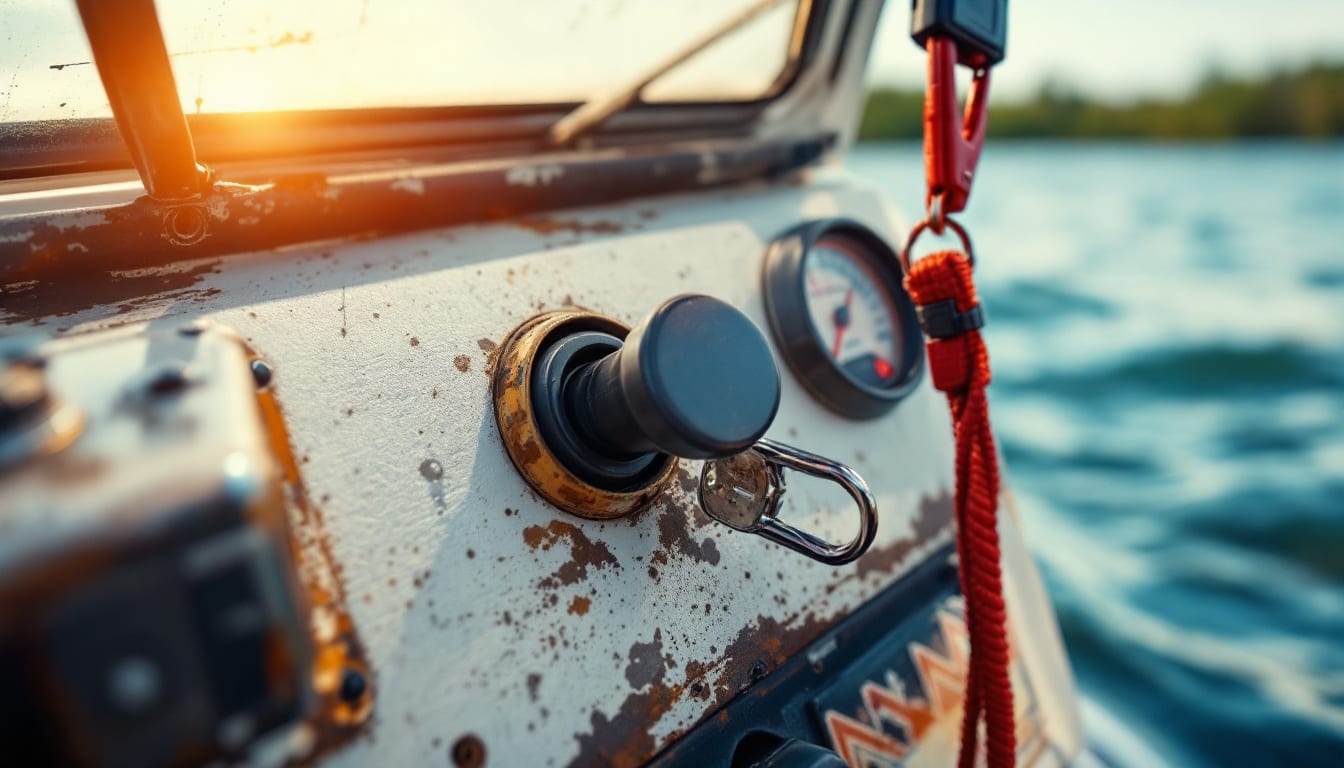
The key goes in. The key turns. And then nothing at all happens — no crank, no click, maybe not even a gauge sweep. On the water this is a bad twenty minutes; in the driveway it is an annoyance. Either way, the key has already done its job, which narrows the problem considerably. Call or text (817) 214-2934 if it turns out to be the lock side.
Quick Answer
As of August 2026: if the key turns, the mechanical lock is working, so a new key almost never fixes this. The realistic causes, in the order worth checking, are the safety lanyard or kill switch, the neutral or shift interlock, the battery and its ground connections, corroded ignition switch contacts, and — less often — a worn key that is not reaching the full start detent. Only the last two are locksmith work. If the switch cylinder is the problem, key or cylinder work generally lands in the low end of our $75–$350 range; a duplicate key is $75–$125.
Start Here: What "The Key Turns" Rules Out
A key that rotates has passed the only test a mechanical lock administers. The wafers aligned, the cylinder released, and it rotated to the position you asked for.
That means you can stop thinking about key cutting, key wear, key codes, and lost-key procedures for the moment. They are not what is stopping the engine. (If the key does not turn, that is a different guide entirely — see key won't turn in the ignition.)
What "the key turns" does not rule out is the ignition switch, the electrical part bolted behind the cylinder. Cylinder and switch are two components sold and replaced separately, and on marine and powersports equipment the switch lives a harder life than the lock does.
Work Through It In This Order
1. The kill switch or lanyard (30 seconds, free)
On a boat this is the number one cause, and it is the first thing an experienced hand checks precisely because it is so common.
The engine cut-off switch — the lanyard clip, the red dead-man switch — must have its clip fully seated. If the clip is missing, half-seated, or the little plate under it has been knocked loose, the starter circuit is open and the engine will not turn over.
The test: remove the clip entirely, reseat it firmly, and try again. If the clip has gone missing, most boats will not start without it, by design. Federal law has required engine cut-off switch use on many recreational vessels since 2021, so a missing lanyard is not a component to bypass — it is one to replace.
On ATVs and side-by-sides, look for the same thing in a different shape: a handlebar kill switch in the OFF position, or a seat-belt or seat-presence interlock on a UTV.
2. The neutral or shift interlock
Nearly all boats, ATVs, and mowers refuse to crank unless the drive is in neutral.
The test on a boat: put the throttle/shift lever fully into neutral, then jiggle it slightly either side of center. A cable that has stretched over several seasons can leave the lever looking like neutral while the switch behind it disagrees.
On a mower or a tractor: the seat switch, the blade engagement lever, and the parking brake are all in the same circuit. Sit down properly, brake on, blades off.
On a side-by-side: seat belt buckled, gear in neutral or park.
This category accounts for a large share of "it just died on me" calls that turn out to be a five-second fix.
3. Battery and grounds
If the interlocks are satisfied and you still get nothing — no click, no crank — it is usually power.
Look for: dim or dead gauges when the key is turned to run. That points at supply rather than the starter circuit.
Check the terminals. On a boat that lives on Lake Granbury, corrosion at the battery posts and at the ground strap is the single most common electrical failure. A white or green crust looks superficial and can be enough to stop a starter cold. On seasonal equipment stored through a winter, a battery that reads 12 volts at rest can still collapse under starter load.
One click and no crank usually means the solenoid is getting a signal but there is not enough current — again, battery or connections, or a failing solenoid.
4. Corroded ignition switch contacts
This is the one that gets blamed on the key and is not the key.
Marine and powersports switches sit in an open dash, in weather, and get splashed. The contacts inside the switch corrode. The result is a key that turns beautifully to START and sends nothing to the starter.
The tell: the key turns crisply, the mechanical feel is normal, gauges may or may not respond, and there is no click from the starter at all. If wiggling the key while holding it at START occasionally produces a crank, you have essentially confirmed it — the contacts are marginal and intermittently touching.
Switch replacement is a job we do routinely on this equipment, and it is a lock-and-switch job rather than an engine job.
5. A worn key that is not reaching full detent
Least likely of the five, but real, and it is genuinely a locksmith problem when it happens.
A badly worn key or a copy-of-a-copy can rotate far enough to reach ACC and RUN, but not far enough — or not squarely enough — to hold the START position. The symptom is a key that feels vague at the far end of its travel, sometimes springing back before the starter engages.
The test: if a second key behaves differently, the key is the problem. A fresh key is $75–$125, which is the cheapest outcome on this whole list. Our boat, ATV and RV key cost guide covers how those keys are made when no original exists.
Which Cause Is Which — At a Glance
| What you observe | Most likely cause | Who fixes it | Typical Granbury cost |
|---|---|---|---|
| No crank, gauges normal, boat | Lanyard or kill switch not seated | You, at the ramp | Free |
| No crank, lever near center | Neutral or shift interlock | You, or a marine tech | Free to shop rate |
| No crank, mower, seat occupied | Seat, brake, or blade interlock | You, or a shop | Free to shop rate |
| Gauges dim or dead at run | Battery, terminals, or ground | You, or a marine tech | Parts and shop rate |
| One click, no crank | Battery under load, or solenoid | Marine or powersports tech | Shop rate |
| Key turns crisply, total silence | Corroded ignition switch contacts | Locksmith or marine tech | Low end of our $75–$350 range |
| Key vague at the far end of travel | Worn key not holding START | Locksmith | $75–$125 for a new key |
| Key will not turn at all | Cylinder or key, not electrical | Locksmith | $75–$125 key, $150–$350 cylinder |
Where the Line Is Between Us and a Marine Mechanic
We would rather tell you this before you pay for a trip than after.
Call us when: the key will not turn, the key is lost or broken, the key turns but feels wrong at the START position, the ignition switch or cylinder needs replacing, or you need keys and locks matched across a boat, trailer, and tow vehicle.
Call a marine or powersports mechanic when: the starter clicks, the battery will not hold charge, the interlocks are electrically faulty, there is fuel or spark trouble once it does crank, or wiring has been damaged. We are not going to diagnose a fuel system, and a shop that offers to is worth being careful with.
Either of us can tell you which it is over the phone if you describe the symptom precisely — specifically whether there is a click, whether the gauges respond, and whether the key feels normal when it turns.
The Ramp Version of This Problem
There is a version of this that becomes an emergency rather than a repair: the boat is in the water, the truck and trailer are in the lot, and nothing will start.
Practical order of operations:
Secure the boat first. Tied off, out of the lane, before anyone starts diagnosing. A ramp lane blocked on a summer Saturday makes a bad day worse for a lot of people.
Check the lanyard and neutral before calling anybody. Those two account for a large share of ramp no-starts and cost nothing.
Separate the two problems. If the tow vehicle is also part of the trouble — keys locked inside, keys in the lake — that is a different job we handle immediately. See our lakefront lockout guide and car lockout service. If the truck keys are genuinely gone, what to do if you lost your car key is the fastest path.
Send a pin. Ramp names help; a dropped map pin helps more. Rural addressing is what delays arrivals in Hood County, not mileage — the detail is in our response-time guide.
Prevention That Actually Works On Lake Equipment
Carry a spare lanyard clip. They cost almost nothing and they are the most common single point of failure on a boat that will not crank.
Clean the battery terminals at the start of the season. Ten minutes with a brush prevents the majority of lake no-starts we hear about.
Get a spare key cut before summer. $75–$125 in the spring beats a decode at a ramp in July, and the boat key is the one that ends up in the water.
Keep the boat key off the truck keyring. They go overboard together otherwise, and then you have two problems and no way home.
If any part of the key or remote for the rig went into the water rather than simply going missing, treat the electronics as a separate problem from the lock - the corrosion damage is usually delayed by days, and the full sequence is in our water-damaged fob and BCM post.
Frequently Asked Questions
My boat key turns but the engine will not crank — do I need a new key? Almost certainly not. A key that turns has already satisfied the lock. Check the lanyard kill switch, then neutral, then the battery and its grounds, then the ignition switch contacts. A new key only helps in the narrow case where a worn key cannot hold the START position.
Why does my boat crank only sometimes? Intermittent cranking usually means a marginal connection: corroded battery terminals, a loose ground, or corroded contacts inside the ignition switch. If wiggling the key at START sometimes produces a crank, the switch is the prime suspect.
Can a locksmith replace a boat ignition switch? Yes — replacing an ignition switch and cylinder and cutting a key to it is lock work, and we do it on marine and powersports equipment. Engine, fuel, and wiring diagnosis belongs to a marine mechanic, and we will say so rather than guess.
My ATV will not crank even though the key turns. What is first? Kill switch in the RUN position, transmission in neutral or park, and on a UTV the seat belt buckled. Those three interlocks account for most no-crank calls. After that, battery and grounds.
How much does a boat or ATV key cost in Granbury? $75–$125 to duplicate a working key or cut from a stamped code, and $100–$300 to originate one by decoding a cylinder when nothing works, as of August 2026. These keys are almost always cheaper than car keys.
Is it legal to bypass the boat's kill switch? No, and it is not a good idea. The engine cut-off switch is a required safety device on many recreational vessels, and a missing lanyard should be replaced rather than jumpered. Replacement clips are inexpensive and widely available.
Do you come out to boat ramps and pastures? Yes. Ramps, marinas, storage lots, pastures, and job sites across Hood County and 25 miles out are normal calls. Send a map pin with your request.
Tell Us the Symptom, Not the Diagnosis
If your boat, side-by-side, mower, or tow vehicle will not start around Lake Granbury, call or text (817) 214-2934 and describe exactly what happens when the key turns — click, no click, gauges or no gauges. Serving Granbury, Acton, DeCordova, Pecan Plantation, Tolar, Lipan, Cresson, Nemo, Bluff Dale, Glen Rose, and 25 miles out. Weekdays 8:00 AM to 7:00 PM, Saturdays 8:00 AM to 5:00 PM, with 24/7 emergency availability. You can also request service through our contact page or read about ignition repair in Granbury.