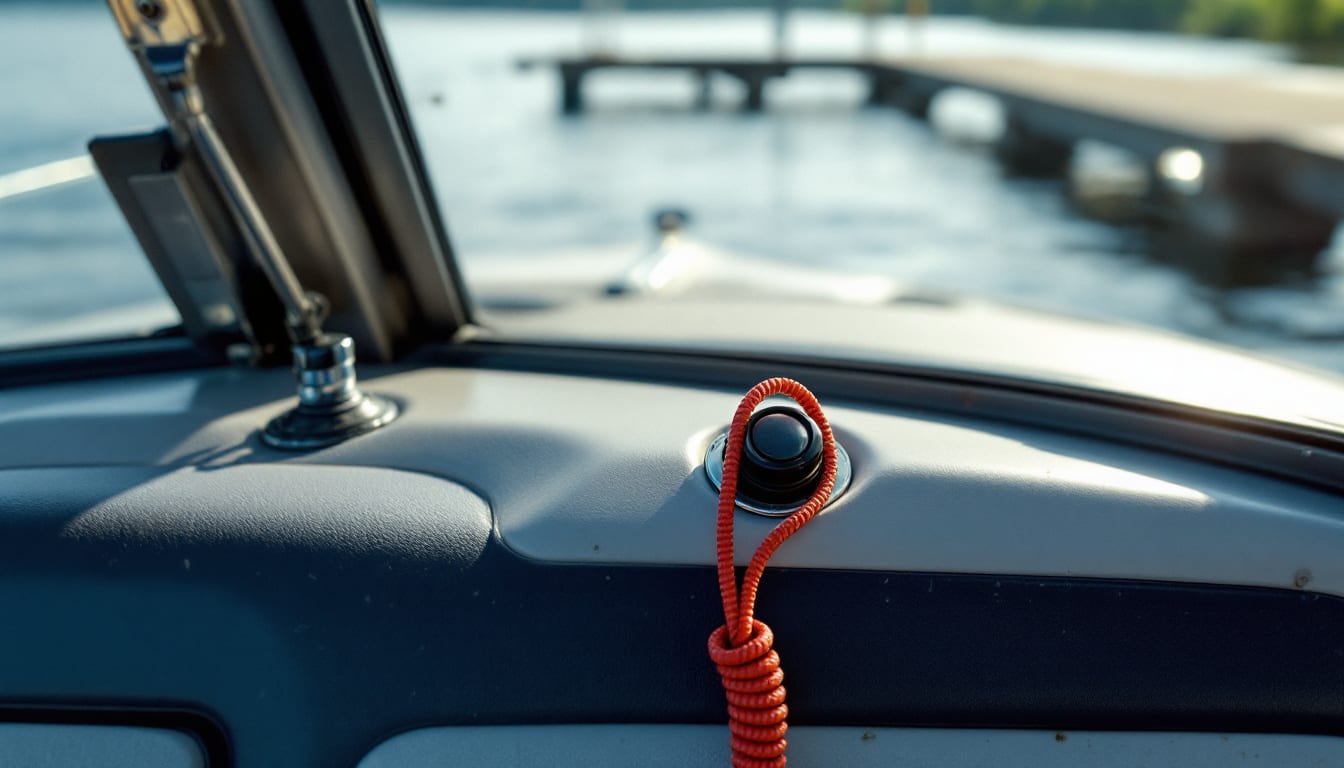
It is a specific kind of bad. The boat is at the ramp — half on the trailer, or tied off and idling in your head — and the only key is somewhere in eight feet of Lake Granbury. Nobody is going home until this is solved. Call or text (817) 214-2934 and we will come to the ramp.
Quick Answer
As of September 2026, a marine ignition key for most boats is a plain mechanical key, and having one cut at the ramp lands in our $75–$125 key band, or $100–$300 when nothing exists to copy and the lock has to be read. That is the common case. The exception is a newer outboard with a factory anti-theft or immobilizer feature, where a key alone may not be enough and the engine's own system has to be satisfied. Before you call anybody, confirm two things: that the engine cutoff lanyard clip is actually seated, and that you are not looking at a dead battery. Both of those look exactly like a key problem from the driver's seat.
First: Do These Three Checks
Every summer we take calls at ramps that are not key problems at all.
1. The engine cutoff lanyard. The clip that sits under the coiled red cord has to be in place for the engine to start. If it went in the water with the key — they usually live on the same ring — the boat will not start no matter what key you put in. A spare clip is a few dollars and lives in the glovebox of every boat that has ever lost one. Federal rules require the cutoff device to be used on most recreational boats under 26 feet, so this part is not optional equipment you can ignore.
2. The battery. A boat that sat since spring, on a lake where nothing has been charged since May, is frequently a battery story wearing a key costume. If the gauges do not sweep and the horn is weak, the key is not your problem.
3. Does another key on the ramp fit? Marine ignition switches, like golf cart switches, historically used a small set of common key patterns per manufacturer. It is genuinely worth walking two boats down and asking. If a neighbor's key starts your engine, you have learned something useful about your boat's security, but you also get to go home today. That same near-universal design is why we treat cart security the way we do in our golf cart key and ignition cost guide.
If all three of those come back clean, it really is the key, and that is fixable at the ramp.
What a Locksmith Can Actually Do at a Boat Ramp
There are three routes to a working key, and which one applies depends on your boat.
Read the ignition switch and cut to it. The most common outcome. Marine ignition switches are wafer locks, and a decoded switch produces a cut key on the spot. No dealer, no marina appointment, no waiting for a parts order.
Cut from a code, if the boat has one. Some ignition switches carry a code stamped on the switch body or documented in the boat's paperwork. If you have the original owner's packet in a drawer at home, it is worth having someone photograph it while we are en route.
Replace the ignition switch. If the switch is corroded past decoding — and marine switches live in salt-free but relentlessly wet, sunbaked conditions — replacement plus a key cut to it lands in our $150–$350 ignition band, the same range we publish for automotive ignition repair.
What a locksmith cannot do is override a factory engine immobilizer that is designed to require the manufacturer's own procedure. If your outboard has a factory anti-theft feature that is armed, a cut key gets you a switch that turns and an engine that still will not run. We tell you that on the phone rather than after we arrive.
Granbury Pricing for Boat Keys
| Job | Typical Granbury range (September 2026) | Notes |
|---|---|---|
| Duplicate a working marine key | $75–$125 | If any key exists to copy |
| Cut a key by reading the ignition switch | $100–$300 | The usual "lost the only one" job |
| Broken key extracted from a marine switch | Low end of $75–$350 | Priced on what the switch looks like inside |
| Ignition switch replacement | $150–$350 | Includes a key cut and tested to it |
| Cabin, hatch, or storage locks rekeyed to match | $50–$150 per lock | Standard rekey band |
| Trailer coupler or toolbox lock keyed to match | $50–$150 per lock | Worth doing on the same visit |
Same bands we publish everywhere else on the site, listed in our auto locksmith services and costs guide, quoted before work starts.
When the Key Is Not Lost — It Is Ruined
A second scenario shows up constantly on this lake: the key was recovered, or there was a spare, and it now does not work because it spent time in the water.
A plain metal key is fine. Dry it, use it. Water does nothing to a wafer key.
A key with electronics in it is a different story. Boats are increasingly sold with fob-style keys and remote systems, and those behave like car fobs: water gets past the seam, sits on the board, and corrodes it over days. The failure is often delayed — the fob works Saturday afternoon and is dead Tuesday. If a truck fob went in with it, the same rules apply, and we walk through the whole water-damage sequence in our water-damaged fob and BCM post.
The short version for anything electronic that got wet: pull the battery immediately, do not press buttons to "test" it, do not put heat on it, and get it looked at rather than hoping.
Proof of Ownership at the Ramp
We will ask, and you should want us to.
A boat sitting at a public ramp with a stranger cutting a key for it is exactly the picture a stolen-boat report is made of. A registration card, title, insurance document with the hull number, or a bill of sale settles it in ten seconds. Texas registers and titles most motorized vessels through Texas Parks and Wildlife, and the registration numbers on the hull should match your paperwork.
Any locksmith who does not ask is a problem — for you as much as for anyone, since it means the same person would cut a key for someone standing next to your boat next weekend. That is one of the red flags we list in our how to vet a locksmith post.
Getting Off the Ramp While You Wait
Practical, ramp-specific things worth knowing, because a busy ramp on a Saturday is not a place to sit for an hour.
Get the rig out of the lane. If the boat is on the trailer, pull to the lot. If it is in the water and the trailer is not, tie off at the courtesy dock rather than holding the ramp. Everyone behind you will be more helpful afterward.
Do not start improvising the ignition. Wiring around a marine ignition switch is how boats get damaged and occasionally how they catch fire. It also disables the safety circuit the cutoff lanyard runs through. Wait for the key.
Take one photo of the ignition panel and text it. The switch style tells us a lot before we arrive — whether it is a common wafer switch, whether there is a keypad or fob receiver, and whether the panel has been replaced.
Have the year, make, and engine ready. Hull manufacturer and model, engine brand and rough year. Those three facts determine whether this is a fifteen-minute job.
After Today: The Habit That Prevents This
There is exactly one lesson from every ramp call we have run.
Keep a spare key somewhere that is not the boat and not your keyring. In the tow vehicle's console, in a magnetic box on the trailer frame, in the tackle bag — anywhere that will not go into the lake attached to the same ring as the first one. A key cut while we are already at your boat costs the low end of a band; a key cut at a ramp on a Sunday afternoon costs a whole afternoon.
Separate the cutoff clip from the key ring. They ride together for convenience and they drown together for the same reason. A spare clip in the glovebox costs almost nothing.
If the boat has an electronic key, treat it like a car fob. Fresh battery each season, and a second one that exists.
We make the same argument for tow vehicles, ATVs, and campers in our boat, ATV, and RV key replacement cost guide, and for daily drivers in our spare car key post.
If the Engine Cranks but Will Not Run
Worth separating out, because it sends people down the wrong path. A key problem usually means nothing happens or the key will not turn. If the engine turns over normally and simply will not fire, the likely culprits are fuel, the cutoff circuit, or — on a newer engine — a security feature. We wrote the full diagnostic for exactly that pattern in our boat and ATV key turns but the engine won't crank guide.
Diagnosing an outboard is a marine mechanic's job. Diagnosing the lock and the key is ours, and we will tell you which one you have before you pay either of us.
Frequently Asked Questions
Can you make a boat key at the ramp? Usually, yes. Most marine ignition switches are mechanical wafer locks that can be read on site and a key cut to them. That is standard mobile work for us at Lake Granbury ramps, and it does not require moving the boat.
How much does a replacement boat key cost in Granbury? As of September 2026, $75–$125 to duplicate an existing key, and $100–$300 to cut one by reading the ignition switch when nothing is left to copy. If the switch itself has to be replaced, that runs $150–$350. The price is quoted before we start.
My boat key is gone and the engine has an anti-theft system. Now what? Then the key is only half the problem. A cut key will turn the switch, but a factory immobilizer still has to be satisfied by the manufacturer's own procedure, which may mean the dealer or a marine technician. Tell us the engine brand and year on the phone and we will say honestly whether a key alone solves it.
The key is gone and so is the red lanyard clip. Does that matter? Yes — badly. The engine cutoff lanyard has to be seated for the engine to start. A new key with no clip in place is still a boat that will not run. Keep a spare clip aboard.
Do you need proof that the boat is mine? Yes. Registration, title, an insurance document with the hull number, or a bill of sale. It takes ten seconds and it is the reason your boat is safer than the one whose locksmith does not ask.
Can you rekey the cabin and storage locks to match the ignition key? Often yes, and it is far cheaper as part of a visit you already have booked. Rekeying runs $50–$150 per lock. The trailer coupler lock and toolbox are worth including while we are there.
How far out do you come? Granbury, Acton, DeCordova, Pecan Plantation, Tolar, Lipan, Cresson, Nemo, Bluff Dale, Glen Rose, and roughly 25 miles out. Our rural coverage and response time post explains what distance realistically means out here.
Call From the Ramp, Not From Home
If you are standing at the water with no key, call or text (817) 214-2934 with the boat make, the engine brand and year, and a photo of the ignition panel. Weekdays 8:00 AM to 7:00 PM, Saturdays 8:00 AM to 5:00 PM, with 24/7 emergency availability. You can also request service through our contact page or read about emergency locksmith service in Granbury.