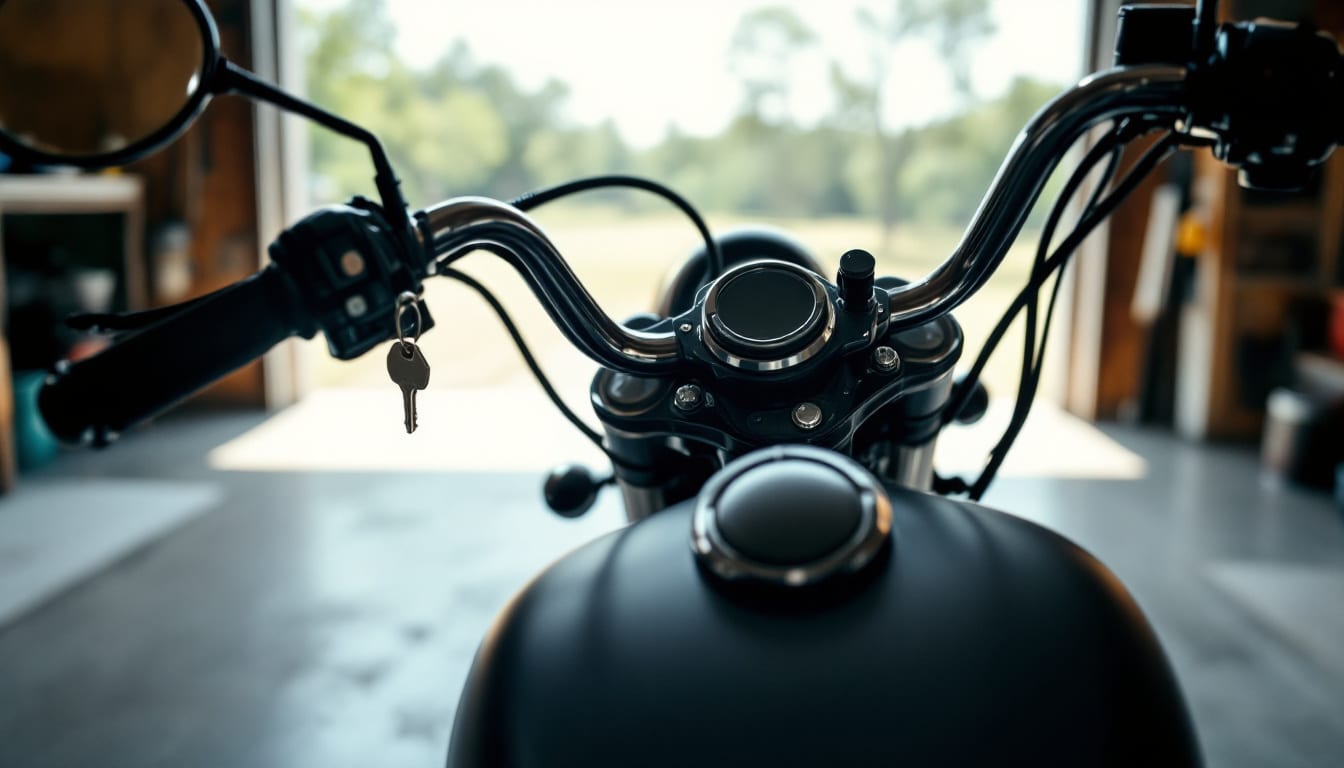
Before you reach for pliers: the most common reason a motorcycle key will not turn is that the steering lock pin is under side load, and the fix takes two seconds and no tools. Call or text (817) 214-2934 if it does not work, but try it first — it usually works.
Quick Answer
As of September 2026, if your motorcycle key will not turn in the ignition, the first thing to try is pushing the handlebars gently in the direction they are already turned, then rocking them slightly while you turn the key. On most bikes the steering lock is a pin sitting in a slot, and the weight of the bike leaning on its sidestand puts pressure on that pin — the key physically cannot rotate until the load comes off. If that does not free it, the usual causes in order are a worn key, grit or water in the cylinder, a bent steering lock pin, and finally a failed ignition switch. Costs in Granbury: a key cut to a working cylinder $75–$125, a key originated with nothing working $100–$300, and ignition switch or cylinder replacement $150–$350 including a key cut to the new part. Broken keys are extracted at the low end of our $75–$350 range.
Try This First, and Do It Gently
Bikes are not cars, and this particular fault is almost always mechanical geometry rather than a broken part.
On most motorcycles the steering lock is integrated into the ignition switch on the top triple clamp: you turn the bars to full lock, push the key in and turn it past off to lock, and a pin drops into a slot in the steering head. To unlock, the pin has to slide back out of that slot. If the pin is being squeezed sideways, it will not move, and the key will not rotate no matter how hard you turn it.
What puts it under load:
- The bike is on its sidestand, leaning, with the bars turned into the lean. Its whole weight is pressing the steering against the stop.
- Someone moved the bike while locked — rolled it, loaded it, or bumped it in a garage — and left the pin loaded.
- The bike is parked nose-down on a slope, so gravity is pushing the steering.
So: stand on the left of the bike, hold the bars, and push them in the direction they are already turned — you are pressing into the stop, which relieves the pin rather than loading it. Then wiggle the bars a few degrees back and forth while you apply light turning pressure to the key. Do not use two hands on the key.
If it is still stuck, get the bike upright and level and try again. Take it off the lean. On a heavy cruiser that may need a second person, and it is worth the minute it costs.
Do not use pliers, a wrench or a screwdriver on the key. A motorcycle key is small, thin and leveraged terribly. Applying tool force is the single most reliable way to turn a five-minute problem into a broken key inside the cylinder, which is a longer and more expensive visit.
If That Did Not Work: the Actual Causes
In the order we find them in Hood County.
A worn key. The most underrated cause, and the most common on a bike that has been ridden for years. The key has a small, thin blade and it lives in a pocket with coins. As the blade wears, the wafers in the cylinder no longer lift to the right heights. The tell is that it worked yesterday but needed jiggling, and it needed jiggling last month too. Usually the bike does not need a lock — it needs a fresh key cut to the original depths, which is the $75–$125 job and the cheapest possible outcome.
Water and grit in the cylinder. A motorcycle ignition points upward. A car's points sideways into a dry cabin. That difference matters more than anything else in this article. A bike parked outside in Texas takes rain, sprinkler water and hose water directly down into the keyway, along with dust, and then bakes. What you get is corrosion on the wafers and a gritty paste where lubricant should be. The symptom is a key that goes in but rotates stiffly or partway.
A bent steering lock pin. Caused by the bike being dropped while locked, or by somebody forcing the bars against an engaged lock — occasionally by a theft attempt. A bent pin will not retract cleanly, and this one does not resolve with technique. It is mechanical repair.
A failed ignition switch. Distinguish this carefully: if the key turns fine and you get nothing, intermittent power, or lights but no starter, the lock is working and the electrical switch behind it is not. That is not a key problem. On most bikes the cylinder and the switch are one assembly, which is why the fix lands in the $150–$350 band.
A broken key already inside. Sometimes the "will not turn" call is really a "half the key is in there" call. Do not fish for it with a screwdriver — the fragment can be pushed deeper past the wafers, and extraction gets harder. Leave it and call.
The wrong key. It happens more than people admit, especially around a household with two bikes, or with a bike bought used that came with a saddlebag key on the same ring.
What This Costs in Granbury
| Job | Typical Granbury range (September 2026) | Notes |
|---|---|---|
| Fresh key cut to a cylinder that still works | $75–$125 | The fix for a worn key — cheapest outcome |
| Duplicate a working motorcycle key | $75–$125 | Do it the same visit for a spare |
| Key originated with nothing working | $100–$300 | Cylinder decoded, key cut and tested |
| Broken key extracted from an ignition | Low end of our $75–$350 range | Quoted after we see the break |
| Ignition switch or cylinder replacement | $150–$350 | Includes a key cut to the new part |
| Saddlebag, seat, helmet or fuel cap locks keyed to match | Quoted per bike | Cheaper bundled into a visit already booked |
| Bent steering lock pin or damaged lock housing | Quoted after inspection | Mechanical repair, not a key job |
| Chipped or immobilizer-equipped bikes | Quoted per model | Some platforms are dealer-only; confirmed first |
| Mobile service inside our 25-mile radius | Included in the quote | No separate trip or call-out fee |
Those bands match the ones published elsewhere on this site, including our motorcycle key replacement cost guide and our ignition repair service page. The multi-lock and mechanical-repair lines are quoted after inspection rather than published as flat numbers, because a bent pin on one bike and a seized housing on another are not the same work.
Chipped Bikes: What Changes
Plenty of riders assume motorcycles escaped the electronics. Many did not.
A large share of bikes from the late 1990s onward carry an immobilizer: a chip in the key or an electronic handshake that the bike's control unit checks before it will run. The manufacturers use different systems and different names for them, and they behave differently when a key is added or lost.
What that means practically:
- If the fault is purely mechanical — the key will not turn, or it is worn, or the cylinder is gritty — the immobilizer is irrelevant. A correctly cut key that also carries your existing chip solves it.
- If you have lost every key to a chipped bike, you are in a different job. On some platforms a new key can be cut and paired on site. On others the pairing is dealer-controlled or requires the bike's original code documentation. We identify which group your model falls into before anyone comes out, because that is the difference between a same-day fix and a tow.
- Fob-based security systems — where the bike is armed and disarmed by a fob or a PIN rather than a chipped key — are a separate matter again, and generally a dealer function.
Tell us the year, make and model on the phone and you will get a straight answer on which of those three you are in. We would rather lose the call than take a deposit for a job that ends at the dealer.
When It Is Not the Key at All
Two situations where a new key changes nothing, worth ruling out before you pay anyone.
Battery. A bike battery that is flat enough to give you a weak dash and no crank can also make the whole thing feel dead in a way owners read as "ignition." If the key turns and the lights are dim or absent, charge or test the battery first.
Safety interlocks. Most modern bikes will not crank with the sidestand down and the bike in gear, and many require the clutch pulled in. A kill switch left in the off position is the single most common no-start of all and the one nobody admits to. Check the run/stop switch, the sidestand, neutral and the clutch before assuming a lock fault.
And one genuine safety point: do not keep riding a bike whose ignition is intermittent. A switch that cuts out under vibration can drop your engine mid-corner or mid-overtake, and on a motorcycle that is not an inconvenience — the National Highway Traffic Safety Administration publishes motorcycle safety material for a reason, and an electrical cut at speed belongs in that category. If your ignition is working "most of the time," treat that as a repair that is due now.
Keeping the Cylinder Alive
Three habits that prevent almost everything above, and they are free.
Carry one key on the ring, nothing else. No fobs, no bottle openers, no house keys. Weight hanging off a top-mounted cylinder is constant side load on wafers designed to be turned and released.
Do not blast the cylinder when you wash the bike. A pressure washer aimed at the top triple clamp pushes water straight down the keyway. Cover it or keep the nozzle away.
Do not fill it with penetrating oil. This is the one most riders get wrong. Wet lubricant in a wafer cylinder collects the dust it just attracted and turns into a paste, and it makes the lock harder to read if a key ever needs originating. A small amount of dry graphite is the traditional answer, and even that should be sparing.
If the bike lives outside — which in Hood County, a lot of them do — a cover is worth more than any lubricant.
Proof of Ownership
We ask on every bike, before we start.
Motorcycles are among the most-stolen vehicle categories and a bike is easy to load into a trailer. Locksmiths working in Texas are regulated through the Texas Department of Public Safety Private Security Program, and verifying ownership is a normal part of the job rather than something we invented for you. A title, a registration, an insurance card, a bill of sale or dealer paperwork all work, and the Texas Department of Motor Vehicles is the record-holder if you need to confirm what you have.
If the bike was bought privately and the paperwork is still in progress, say so when you call — we can usually work with what you have, but not with nothing.
What We Need Before We Come Out
Photographs beat descriptions every time. Text these to (817) 214-2934:
- Year, make and model.
- A photograph of the ignition switch as it sits on the bike now.
- A photograph of your key, both faces, blade in focus. Wear is visible in a photo.
- What exactly happens: key will not go in, goes in and will not turn, turns partway, turns freely with no result, or turns fine but the bike is dead.
- Whether the bars are at full lock and whether the bike is on its stand or upright.
- Whether you have any other key for the bike, including saddlebag or seat keys.
- Where the bike is, and whether it can be moved at all.
How the Visit Runs
We start with the geometry, because it is free and it is usually the answer — bike upright, load off the pin, light key pressure.
If the lock is genuinely at fault, the cylinder is inspected and the decision is made in front of you: a fresh key to the existing cylinder, a cleaned and serviced cylinder, or a replacement assembly. Each of those is a different number and you hear which one before it happens.
If a key is broken inside, extraction comes first, and only then do we know whether the cylinder survived intact.
Then everything gets tested properly: key in and out several times, steering lock engaged and released with the bike upright and on the stand, and the bike started and shut down more than once. A lock that works in a garage on level concrete and jams in a gravel driveway on a lean has not been tested.
Before we leave, cut a spare. It is $75–$125 while we are standing there, and the alternative — originating a key with nothing working, at $100–$300, on a day you needed to ride — is the whole reason this article exists.
Frequently Asked Questions
Why won't my motorcycle key turn in the ignition? Most often the steering lock pin is under side load, because the bike is leaning on its sidestand with the bars turned into the lean. Push the bars in the direction they are already turned, rock them slightly, and apply light pressure to the key. If that fails, get the bike upright and level and try again before assuming anything is broken.
How do I unjam a motorcycle fork lock? Relieve the pressure on the locking pin rather than forcing the key. Bars pushed further into the stop, bike upright off the lean, gentle rocking of the bars, light turning pressure. Never use pliers or a wrench on the key — a motorcycle key is thin and small, and tool force is how it snaps off inside the cylinder.
My key turns but the bike is dead. Is that the ignition? Probably the electrical switch rather than the lock, but check the free things first: the run/stop kill switch, the sidestand, neutral, the clutch and the battery. If those are right and the key turns with no result or intermittent power, the switch assembly is the likely fault, which is the $150–$350 band including a key cut to the new part.
How much does a motorcycle ignition switch replacement cost in Granbury? $150–$350, including cutting a key to the new assembly. A fresh key to a cylinder that still works is much cheaper at $75–$125, and on a bike whose only real problem is a worn key that is all it needs. We diagnose before quoting a part.
Can you make a motorcycle key if I have lost all of them? Usually yes on a mechanical bike — the cylinder is decoded and a key cut and tested, in the $100–$300 band. On a bike with an immobilizer it depends on the platform: some can be paired on site, others are dealer-controlled. Tell us the year, make and model and we will identify which before anyone comes out.
My key broke off in the motorcycle ignition. What now? Leave it alone. Fishing with a screwdriver or a blade pushes the fragment deeper past the wafers and makes extraction harder and more expensive. Extraction sits at the low end of our $75–$350 range, and only once the fragment is out can anyone tell whether the cylinder survived.
Should I spray lubricant into a sticky motorcycle ignition? Not penetrating oil. Wet lubricant in a wafer cylinder attracts dust and turns into a paste, and it makes the lock harder to read if a key ever needs originating. Sparing dry graphite is the traditional answer. The bigger wins are keeping the pressure washer away from the top clamp and carrying one key on the ring, nothing else.
Do you come to the bike, or does it need transporting? We come to you, anywhere inside 25 miles of Granbury with no separate trip fee — Acton, DeCordova, Pecan Plantation, Tolar, Lipan, Cresson, Nemo, Bluff Dale, Glen Rose and out to the county lines. A bike that cannot be started or steered is exactly the case mobile service exists for.
Get It Turning Again
Send a photo of the ignition and your key, tell us what happens when you turn it, and you will get a real answer rather than a range. Call or text (817) 214-2934, weekdays 8:00 AM to 7:00 PM, Saturdays 8:00 AM to 5:00 PM, with 24/7 emergency availability. You can also request service through our contact page, read what a motorcycle key costs in 2026, or see the car-side version of this fault in why an older vehicle's key will not turn in the ignition.
Sources
- National Highway Traffic Safety Administration — motorcycle safety
- Texas Department of Public Safety — Private Security Program
- Texas Department of Motor Vehicles — titles and registration
- National Insurance Crime Bureau — vehicle theft prevention resources
- Associated Locksmiths of America
- National Automotive Service Task Force — Vehicle Security Professional Program