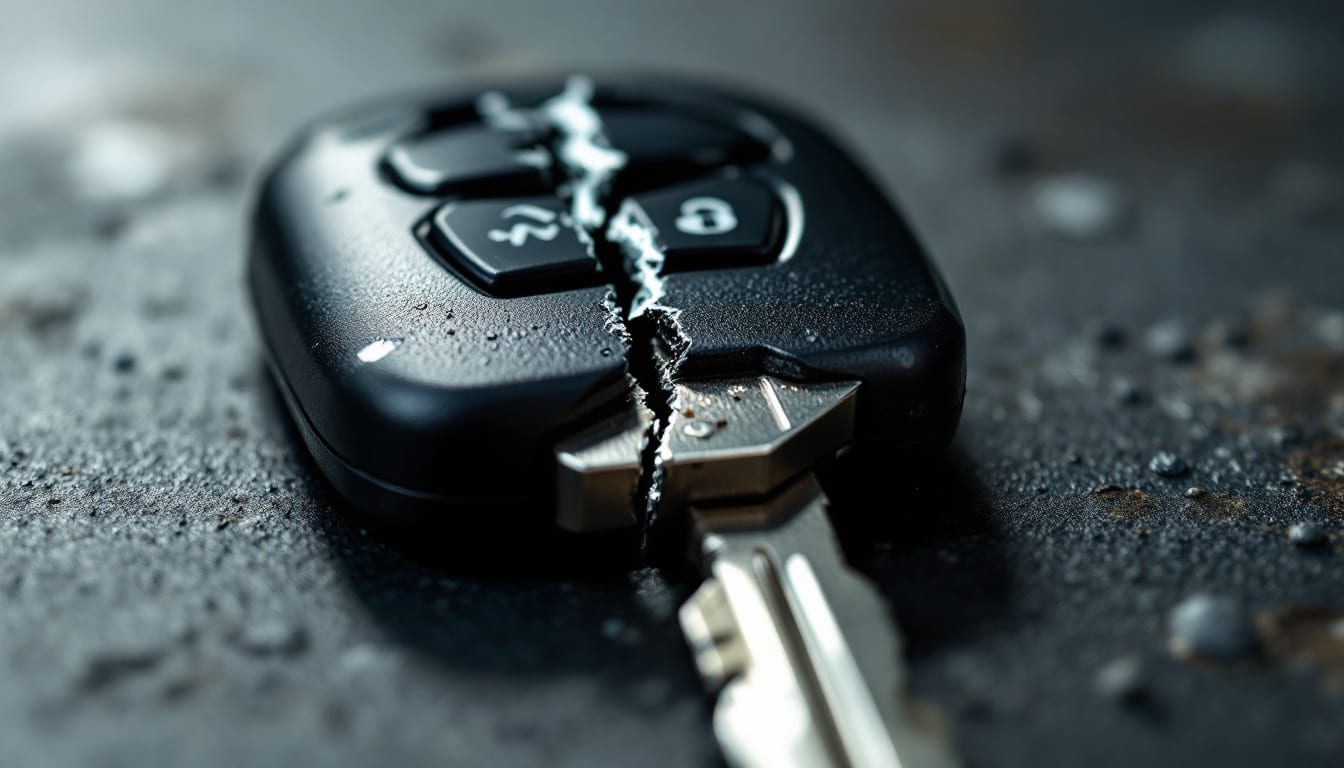
A damaged key is the one automotive lock problem that always gets worse and never gets better, and most people wait until it strands them. Call or text (817) 214-2934 and we will cut and program a fresh one where the vehicle sits.
Quick Answer
If your transponder key is cracked, worn smooth, snapped, or water-damaged, a mobile locksmith can cut and program a replacement at your Granbury location, usually the same day, without a tow. As of August 2026 a replacement transponder key here generally runs $80–$185 if the damaged key still works well enough to read, and $185–$325 if it is dead and no other working key exists. The appointment takes 20 to 45 minutes. The fastest and cheapest version of this job is the one you book while the damaged key still starts the engine — waiting until it fails entirely roughly doubles the cost and adds a stranded vehicle to the bill.
The Four Ways a Transponder Key Dies
A transponder key is two things sharing a plastic body: a cut metal blade that works the lock, and a chip that answers the immobilizer. Either half can fail independently, and knowing which one you are dealing with determines the price.
The blade wears down. This is the slow one. Every insertion scrapes a little metal, and after a decade the peaks and valleys the lock reads have rounded off. Symptom: the key works, but only at a certain angle, or only after wiggling. The lock is fine — the key has quietly stopped matching it. A blade cut fresh from your VIN's factory code, rather than copied from the worn key, restores the original shape.
The head cracks and the chip loosens. The plastic head takes the leverage every time you turn the ignition, and heat cycles in a Texas summer make it brittle. Once it splits, the transponder chip inside can shift out of range of the antenna ring around the ignition. Symptom: intermittent no-starts that a squeeze of the key head sometimes fixes.
The key snaps. Usually at the shoulder where the blade meets the head, usually in the lock or the ignition, usually on the coldest or wettest morning available. The chip is generally still fine; the blade is not.
Water gets in. Lake Granbury swims, boat ramps, stock tanks, and washing machines. A bladed transponder chip is more water-tolerant than a battery-powered remote, but immersion plus time equals corrosion on the contacts inside a remote-head key.
What Can Be Saved and What Cannot
| Damage | Can it be salvaged? | Typical Granbury range (August 2026) |
|---|---|---|
| Blade worn, key still turns | Recut blade to VIN code, keep chip | $80–$185 |
| Head cracked, chip intact | Rehouse chip in a new shell, or new key | $80–$185 |
| Snapped blade, piece in the lock | Extract, then cut and program a new key | $120–$250 |
| Snapped blade, another working key exists | New key cut and programmed | $80–$185 |
| Key dead and it was the only one | All keys lost procedure | $185–$325 |
| Remote-head key, buttons dead only | Often just a coin cell | $10–$50 |
| Water-damaged remote head | Usually replaced, not repaired | $120–$250 |
| Ignition cylinder damaged by the key | Cylinder repair or replacement | $180–$400 |
The single most expensive line on that table is the one you fall into by waiting. Everything above "key dead and it was the only one" is a scheduled appointment on a drivable vehicle. That row is a recovery job on a vehicle that is not going anywhere.
The Fastest and Cheapest Route, In Order
1. Establish whether a second working key exists. Not "somewhere in the house" — actually located and actually tested by starting the engine. This one fact is worth roughly a hundred and fifty dollars, because with a working key present the job is a duplication and without one it is a security procedure.
2. Do not keep using a key that is failing. A rounded blade forced into a worn cylinder wears the cylinder, and an ignition cylinder replacement costs more than the key that destroyed it. If your key only works at one angle, you are currently paying for a future ignition repair in installments.
3. Call with the VIN, not the key. A locksmith cuts from the code tied to your VIN. That produces a blade shaped the way the factory shaped it, which is better than a copy of a worn key — and it works even if the original is in three pieces.
4. Have the key extracted properly if it broke off in the lock. A snapped blade in an ignition cylinder can usually be extracted with the correct tool in minutes. The same blade after somebody has tried needle-nose pliers and a paperclip is frequently a cylinder replacement. This is the single most common way a $120 job becomes a $400 job in this county.
5. Get two keys made, not one. The price gap between one key and two at the same appointment is small, because the expensive part — the trip, the diagnosis, the security access — happens once. Doing it later as a separate visit costs the trip again.
If you are already past step one and have nothing that works, our lost car key with no spare guide covers that path, and emergency car key replacement in Granbury covers the after-hours version.
Why a Copy of a Worn Key Is the Wrong Fix
Hardware stores and kiosk machines duplicate by tracing. The cutter follows the key you hand it and reproduces whatever shape it finds — including a decade of wear. You get a second key that is already worn out, and now two bad keys are grinding the same cylinder.
Cutting to code is different. The vehicle's key code, retrieved against the VIN, describes the blade the factory cut when the vehicle was new. A key cut that way fits the lock the way the lock was designed to be fit. If your current key is marginal, this is the reason a locksmith key often feels better than the one you have been using.
The same logic explains why a traced copy frequently will not start the vehicle at all: tracing reproduces the metal and does nothing about the chip. An unprogrammed blade turns the cylinder and the engine cranks without firing. That is not a defective key — it is a key the vehicle has never been introduced to. We cover the distinction in transponder key vs. smart key vs. key fob, and the can a locksmith make a car key without the original guide answers the follow-up most people ask next.
The Symptom That Is Not the Key at All
Before you buy anything, rule out two impostors.
A weak 12-volt battery. A battery with just enough charge to light the dash and turn the starter slowly can still be too weak for the immobilizer handshake to complete reliably. The result looks exactly like a failing key: cranks, will not start, security light on. Check the battery first. It is free and it is right more often than people expect.
A failing ignition cylinder. If the key turns but feels loose, gritty, or has to be held in position, the cylinder is worn rather than the key. A new key will feel better for a few weeks and then present the same symptom. On older trucks and higher-mileage vehicles this is common enough that we look at it before selling a key. The all-vehicle ignition repair guide walks through how to tell them apart.
A technician who sells you a key without asking about either of these has not diagnosed anything.
What the Appointment Looks Like
There is no shop visit and no tow. A van arrives at your address, gate, driveway, or job site anywhere in Granbury or the 25-mile radius.
Ownership is verified first — registration, title, or insurance in your name plus a matching photo ID. That check is required under the Texas Department of Public Safety Private Security Program, and it is deliberately the step a thief cannot pass.
The blade is cut to your VIN's code on the truck. If a chip needs to be rehoused or a broken piece extracted from the cylinder, that happens next. Then the key is programmed to your vehicle's immobilizer — the vehicle has to learn the new credential, which is why this cannot be done at a counter. You test it by starting the engine before anyone leaves.
Twenty to forty-five minutes for most vehicles, plus drive time. The vehicle never moves.
The Honest Boundary
Two limits stated before quoting rather than after arriving.
The newest model years get a VIN check first, because manufacturer key-access rules move by build year and we would rather tell you today than in your driveway. And if the fault turns out to be the immobilizer module rather than the key, that is a different and larger job described on our immobilizer programming page — not something to discover halfway through.
Anyone quoting any vehicle, any year, sight unseen and without a single question is guessing with your money. The red flags worth knowing are short and they are all avoidable.
Frequently Asked Questions
My transponder key is damaged — what is the fastest and cheapest option in Granbury? Call a mobile locksmith with your VIN while the damaged key still starts the vehicle. As of August 2026 that path runs $80–$185 and takes 20 to 45 minutes at your location. Waiting until the key dies entirely moves you into the all-keys-lost range of $185–$325 and parks the vehicle.
Can you use my broken key to make a new one? Often we do not need it. The replacement blade is cut from the code tied to your VIN, which is more accurate than copying a worn or snapped key. Bring the pieces anyway — the chip inside is sometimes reusable.
My key snapped off in the ignition. Now what? Stop and leave it. A blade extracted with the proper tool is usually a minutes-long job; the same blade after pliers and glue attempts often means replacing the cylinder. Call before improvising.
The key head cracked and now it starts only sometimes. Is that the chip? Very likely. A split head lets the transponder chip drift out of range of the antenna around the ignition. It can frequently be rehoused into a fresh shell rather than replaced outright.
Will a hardware-store copy work? It will turn the lock and it will not start the engine on any vehicle with an immobilizer, because copying reproduces the metal and does nothing about the chip. It also copies the wear in your current key.
My key went in the lake. Is it worth drying out? A bladed transponder key sometimes survives; a remote-head key with a battery usually does not, because corrosion continues after it looks dry. If it is your only key, replace it rather than gamble on it.
Do you carry blanks for my vehicle? For the overwhelming majority of makes on the road here, yes. Uncommon European and low-volume models occasionally need a blank ordered, and you will be told that on the phone rather than after a wasted trip.
Get a Fresh Key Cut Before the Old One Quits
Call or text (817) 214-2934 with your year, make, model, and whether the damaged key still starts the vehicle. Serving Granbury, Acton, DeCordova, Pecan Plantation, Tolar, Lipan, Cresson, Nemo, Bluff Dale, Glen Rose, and 25 miles out. Weekdays 8:00 AM to 7:00 PM, Saturdays 8:00 AM to 5:00 PM, 24/7 emergency availability. You can also request service through our contact page or see transponder key programming in Granbury.
Sources
- Texas Department of Public Safety — Private Security Program
- National Automotive Service Task Force — Vehicle Security Professional Program
- Associated Locksmiths of America
- National Highway Traffic Safety Administration — Vehicle Theft Prevention
- Federal Trade Commission — How to Find a Good Auto Repair Shop
- National Insurance Crime Bureau