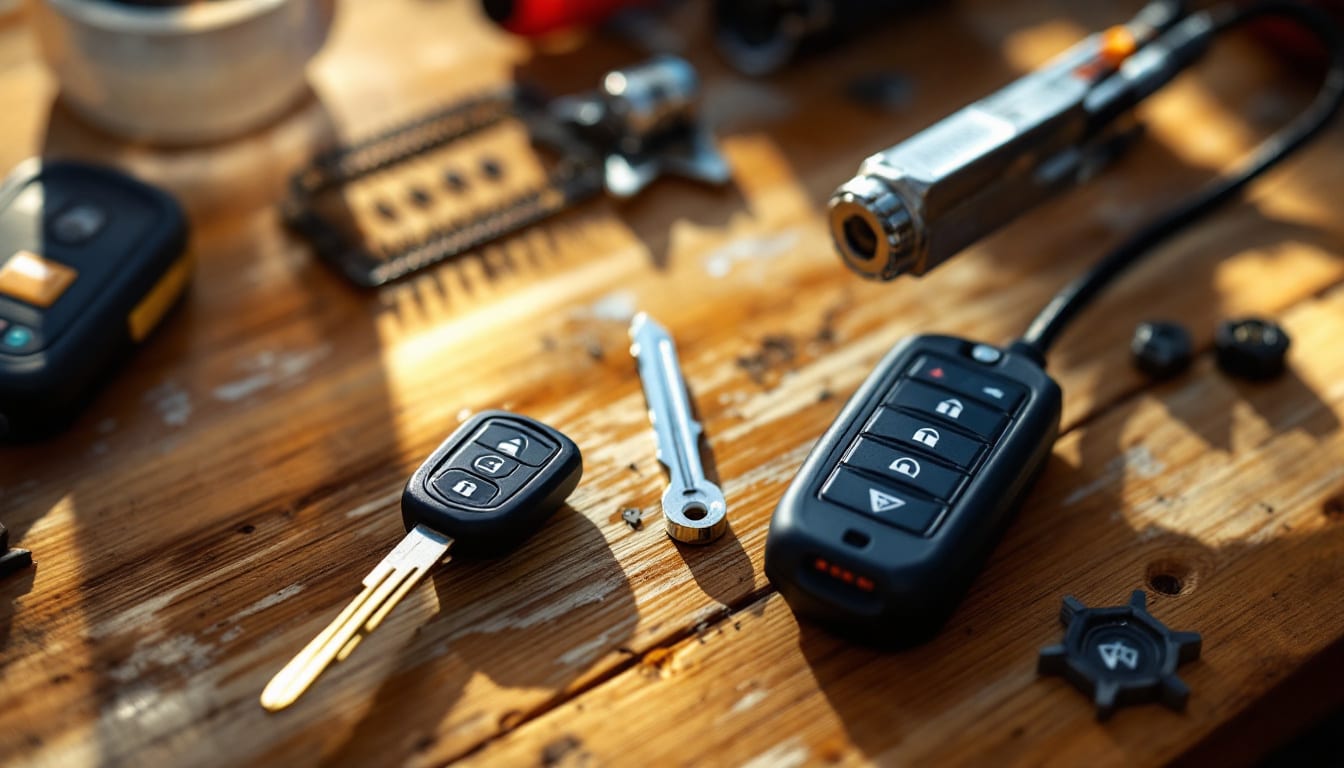
No. A qualified mobile locksmith can cut and program a Chevrolet or GMC transponder key in Granbury without any dealership involvement — including when you have lost every key. As of August 2026, transponder key work in Hood County typically runs $80–$350 depending on the vehicle and whether a key still works, versus $200–$600 or more at a dealer that also needs your vehicle physically at their service drive. Call or text (817) 214-2934 for a firm number on your VIN.
The Short Version, Then the Detail
The dealership myth persists because it used to be true. In the 1990s and early 2000s, when transponder immobilizers first appeared, dealers really did have exclusive tooling. That has not been the situation for a long time. Independent automotive locksmiths carry diagnostic equipment that performs the same key-origination and immobilizer relearn functions, and there is a formal industry channel for the security data that requires it.
That channel is the National Automotive Service Task Force Vehicle Security Professional program — a credentialing system created precisely so qualified non-dealer technicians can legitimately access manufacturer-restricted security information. It is not a workaround. It is the sanctioned path, and it is why the question "do I need the dealer" has a clear answer for the great majority of GM vehicles on Hood County roads.
What a Chevy or GMC Transponder Key Costs in Granbury
| Scenario | Locksmith range (Granbury, July 2026) | Dealer route |
|---|---|---|
| Spare transponder key, one still works | $80–$185 | Vehicle must be at the dealer |
| Transponder key, all keys lost | $185–$325 | Tow or drive out of county, plus wait |
| Proximity smart key spare (push-button) | $150–$350 | $200–$600+ typical starting range |
| Proximity all keys lost | Quoted per vehicle | Higher, plus appointment scheduling |
| Key programming only, customer-supplied key | $80–$185 | Often declined outright |
| Immobilizer or module programming | $120–$500 | Varies |
| Ignition cylinder repair | $150–$350 | Usually a shop-visit job |
Mobile locksmith service in this market generally runs 40–60% below dealership pricing for equivalent key work. Our full breakdown by vehicle type lives on the car key replacement Granbury page, and there is a broader dealer cost comparison here.
The Cost Nobody Quotes You: Getting There
Here is the part that changes the math specifically for Hood County, and it has nothing to do with the key.
There is no Chevrolet or GMC dealership inside Granbury. If your vehicle needs to reach a GM service department, it is leaving the county — toward Weatherford, Cleburne, or Fort Worth. That produces three costs a dealer quote never mentions:
The tow, if the vehicle will not start. An all-keys-lost vehicle cannot be driven to the dealer by definition. Somebody has to haul it, and if it is a heavy-duty truck with a trailer attached, that is a bigger job than a flatbed for a sedan.
The round trip, if it will start. Two drivers, or one driver and a long wait, plus fuel and most of a working day.
The appointment. Dealer service departments schedule. Mobile locksmiths dispatch. A key that is available Thursday at 2:00 PM is not much comfort on a Monday morning when the truck is needed on a job.
Add those to a dealer's parts-and-labor quote and the comparison stops being close.
How Transponder Keys Actually Work on GM Vehicles
Understanding the mechanism explains why an independent can do the job.
A transponder key carries a small passive chip in the head. When you insert and turn it, the vehicle's immobilizer antenna energizes the chip, reads its code, and compares that to what the security module expects. Match, and the engine is allowed to run. No match, and you get the classic symptom: the engine fires for a second or two and dies.
Making a new key means two independent steps.
Cutting the mechanical blade. With an existing key, the cut can be duplicated. Without one, the cut must be originated from VIN-derived key code data — which is why all-keys-lost costs more than a spare.
Programming the chip to the vehicle. With a working key, many GM vehicles allow a simplified on-board add. With none, the security module must be authenticated to accept the first key. On many GM models this includes a timed relearn cycle — commonly three consecutive ten-minute intervals with the ignition on, thirty minutes total. That is a GM design requirement, not a locksmith stalling. Nobody can skip it.
Push-button vehicles substitute a proximity fob for the bladed key and add the keyless-entry module to the picture, but the principle is identical. The model-specific version of that relearn is walked through in our Silverado 1500 push-to-start key and BCM relearn guide, and the bladed-key generation just before it is covered in Silverado 1500 transponder key and remote start, 2014-2018.
When the Dealer IS the Right Call
Honest answer, because "always call us" is not credible advice.
Warranty work. If the vehicle is under warranty and the fault is a failed security or body control module rather than a lost key, let the dealer replace it under coverage. Do not pay us for something GM owes you.
The newest security-gateway vehicles. Manufacturers have tightened access on the most recent model years, and some operations remain genuinely dealer-only for certain builds. We check your VIN before quoting and we tell you when that is the answer.
A failed module, not a lost key. If the immobilizer or body control module has failed rather than lost its key data, that is module work with a different scope. Sometimes we can handle it; sometimes it belongs at a dealer.
Manufacturer recalls or open campaigns. If your ignition or security system is subject to an open recall, that work is free at a dealer. Check your VIN at the NHTSA recall lookup before paying anyone.
Per the Federal Trade Commission's auto repair guidance, you are entitled to a clear estimate and an explanation of the work. That applies equally to us and to a dealer — and any shop unwilling to tell you when someone else is the better answer is not one to trust with a quote either.
Where the Dealership Myth Came From
It is worth understanding why so many people still believe the dealer is mandatory, because the belief is not stupid — it is just out of date.
It is also worth knowing where the transponder era actually starts. GM's full-size trucks from the late 1980s and 1990s carry no chip at all, and their keys are among the cheapest we cut — see Chevy C/K 1500 and Suburban key replacement, 1988-1998.
The early immobilizer years. When transponder systems rolled out broadly in the late 1990s, the tooling genuinely was scarce and expensive, and the security data was tightly held. For several years, "go to the dealer" was accurate advice for a lot of vehicles.
Parts-counter framing. Dealers sell keys as parts, and a parts department has no incentive to mention that an independent can supply and program the same thing. Nobody is lying to you; you are simply not being told about an option that competes with them.
Confusion between key cutting and key programming. A hardware store or big-box kiosk can cut a blade but cannot program a transponder. Owners who tried that route, watched it fail to start the vehicle, and concluded "only the dealer can do this" drew a reasonable conclusion from an incomplete experiment. The missing capability was programming, not dealership status.
Right-to-repair progress. Over the last two decades, formal channels for independent access to service and security information have expanded considerably, with the credentialing system described above as the vehicle-security piece. That is what changed the answer.
The practical result today is that most GM key work is a competitive service. Where it is not — the newest gateway-restricted builds, warranty module work, and open recalls — the dealer is genuinely the right call, and we say so.
How to Tell a Real Automotive Locksmith From a Lead Broker
This matters more than the dealer question, because the actual risk in this market is not the dealership — it is an out-of-area call center that dispatches whoever answers and quotes a price that triples on arrival.
Signs you are talking to the real thing:
- They ask for your VIN, year, trim, and key count before quoting. A price given without those is not a quote, it is bait.
- The quote does not change on arrival. Ask directly: "Is that the total, including the trip?"
- They verify ownership. Texas locksmiths operate under the Texas Department of Public Safety Private Security Program — never TDLR, which regulates other trades entirely. Any legitimate shop will ask for registration or title plus matching photo ID before originating a key. A shop that does not ask is a shop that will originate a key for someone else's vehicle too.
- They know which relearn your vehicle needs and will tell you the job includes a thirty-minute security cycle if it does.
- They have a local number and a local service radius. Ours is 25 miles from Granbury, covering Acton, DeCordova, Pecan Plantation, Tolar, Lipan, Cresson, Nemo, Bluff Dale, and the Glen Rose and Weatherford edges.
What to Have Ready When You Call
- VIN — driver-door jamb sticker or base of the windshield. A photo texted with your request gets you an accurate quote faster than reading it aloud.
- Year, model, and trim, plus whether the vehicle has a key slot or a push-button start.
- Honest key count — one working key or none. This is the single largest price factor.
- Proof of ownership — registration, title, or insurance matching your ID; a fleet letter for company vehicles.
- Exact location — a cross street or map pin beats a rural mailbox address every time.
Frequently Asked Questions
Can a locksmith program a Chevy transponder key, or does it have to be the dealer? A qualified automotive locksmith can program Chevrolet and GMC transponder keys, including all-keys-lost situations. Independent access to manufacturer security data runs through the NASTF Vehicle Security Professional program. The dealer is not required for the large majority of GM vehicles on the road in Hood County.
How much cheaper is a locksmith than the dealership in Granbury? Typically 40–60% less for equivalent key services, before counting the tow or round trip to a dealer outside the county. As of August 2026, transponder key work here generally runs $80–$350 versus $200–$600 or more at a dealer.
Do I need to tow my truck anywhere? No. Mobile service means the technician comes to your home, job site, roadside, or boat ramp. Not towing is most of the savings on an all-keys-lost job.
Why does all-keys-lost cost more than a spare? Two reasons. The mechanical cut has to be originated from VIN data instead of duplicated, and the security system has to be authenticated to accept the first key rather than simply adding another. Different equipment, different time, different price.
How long does GM key programming take? Typically 30 to 90 minutes on site. On many GM models a security relearn adds a mandatory thirty-minute timed cycle that no shop can shorten — if someone promises a five-minute all-keys-lost job on a vehicle that requires it, they are guessing.
Will programming a new key erase my existing keys? Not usually for a simple add. Some all-keys-lost procedures do clear previously paired keys by design, which is exactly what you want when a key has been lost or stolen. We tell you which applies to your vehicle before we start.
Are locksmiths in Texas licensed? Texas regulates locksmith and vehicle-security work through the Department of Public Safety Private Security Program — not TDLR. Ownership verification before key origination is part of that framework, which is why we ask for documents rather than just taking your word.
Get a Real Number on Your Vehicle
If you need a Chevrolet or GMC key cut and programmed in Granbury, call or text (817) 214-2934 with your VIN, trim, and key count and we will give you the actual price before anyone drives anywhere. Serving Granbury and all of Hood County within 25 miles. Weekdays 8:00 AM to 7:00 PM, Saturdays 8:00 AM to 5:00 PM, with 24/7 emergency availability for emergency car key replacement in Granbury. You can also request a quote here, read what to do if you lost your car key, or see whether a locksmith can make a key without the original.